

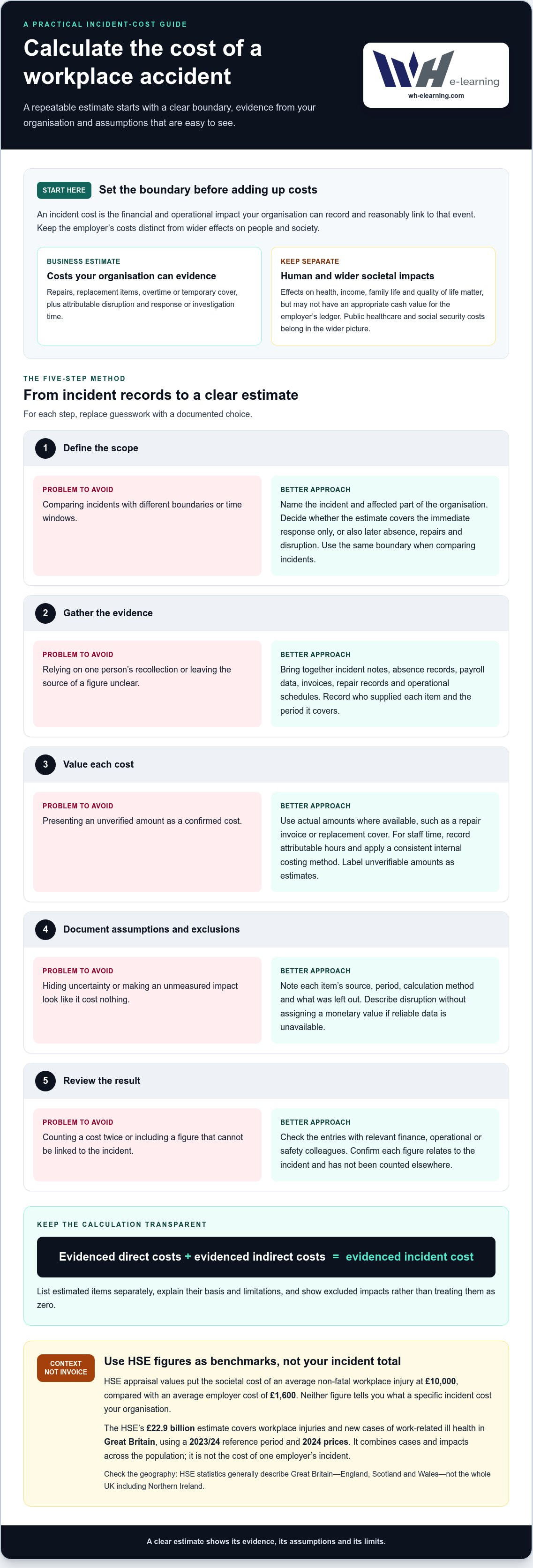
HSE appraisal values put the societal cost of an average non-fatal workplace injury at £10,000, compared with an average employer cost of £1,600. Both figures offer useful context, but neither tells you what a specific incident has cost your organisation. That distinction matters when calculating the cost of workplace accidents UK employers actually bear.
If it’s difficult to capture investigation time, lost output, staff cover and other indirect costs, you’re not alone. Published estimates provide context, not a ready-made figure for your accounts. A clearer estimate starts with your incident records and separates costs to the business from wider costs to individuals and society.
This guide shows you how to build a repeatable, incident-level calculation, use HSE appraisal values as benchmarks rather than invoices, and present findings clearly. A well-evidenced cost summary can also help compare prevention options and explain why safer equipment, procedures or staff awareness deserve consideration.
Key Takeaways
- Make calculating the cost of workplace accidents UK-specific by using incident evidence and costs your organisation can reasonably attribute to the event.
- Set a clear time period and cost scope, then gather records to estimate direct and less visible impacts.
- Use HSE appraisal values and calculators for context, not as automatic invoices or substitutes for your own figures.
- Look for recurring cost drivers to guide prevention priorities, without assigning blame to injured workers.
- Support clearer incident records and risk awareness with WH eLearning’s Accident Reporting Training and Risk Assessment in the Workplace Training, each priced at €35 per course.
What does calculating the cost of workplace accidents in the UK include?
Start with the incident and the organisation affected. An incident cost is not every consequence that follows an injury. It is the financial and operational impact your organisation can record and reasonably link to that event. Set clear boundaries so the result is consistent and useful for decisions.
Quotable definition: “A business’s incident cost is the recorded, reasonably attributable impact on that organisation; an HSE appraisal value is a benchmark estimate for assessing cases or policy, not a bill for a particular employer.”
Direct, indirect and human costs: what belongs in the picture?
Build the business estimate from evidence, not assumptions. Direct costs may include equipment repairs, replacement items, overtime or temporary cover when records link them to the incident. Indirect costs can include disrupted work, managers’ response and investigation time, and delays while a task or process is reorganised. Timesheets, work schedules and incident notes can help you explain how you estimated these less visible costs.
Keep the effects on people visible, but separate them from the employer’s ledger. An injury may affect a worker’s health, income, family life and quality of life. These impacts matter, but they may not have a precise or appropriate cash value for an organisation to record. Government costs, such as public healthcare or social security, belong in the wider picture rather than the employer’s direct incident total. Separating these categories helps avoid presenting social harm as a business expense.
Why UK-wide estimates are not your organisation’s bill
National estimates combine information across a defined population, period and set of cost categories. For example, the HSE’s estimate of £22.9 billion relates to the cost of workplace injuries and new cases of work-related ill health in Great Britain, using a 2023/24 reference period and 2024 prices. It combines cases and impacts across the population, so it does not show what one incident cost a specific employer.
Check the geography as well as the date. HSE statistics generally describe Great Britain, which comprises England, Scotland and Wales, rather than the whole UK including Northern Ireland. The Health and Safety Executive is the regulator whose published statistics and appraisal models provide useful context. The population and definitions behind each figure still matter.
This distinction is central to calculating the cost of workplace accidents UK organisations actually experience. Use national figures to frame the scale of the issue, not to fill gaps in your accounts. For an incident-level estimate, record what happened, identify the costs your organisation bore, and retain the evidence and assumptions behind each entry. The result will be easier to explain and compare, without implying that every consequence can be reduced to a precise sum.
How to calculate the cost of a workplace accident step by step
A repeatable calculation does not need to capture every possible consequence. It needs a clear scope, evidence for the costs included, and visible assumptions where records are incomplete. That makes calculating the cost of workplace accidents UK organisations can explain more useful than presenting a figure without its working.
Gather evidence for absence, disruption and incident response
Bring together records from the teams involved rather than relying on one person’s recollection. Check absence dates and cover arrangements, payroll or timesheets for additional hours, and supplier records for repairs, replacement equipment or external services. Ask managers to record response and investigation time, and operational teams to describe any disruption. Keep estimated amounts separate from documented costs.
Use this five-step process for each incident:
- Define the scope. Identify the incident, the part of the organisation affected and the time window. Decide whether to include only the immediate response or also later absence, repairs and disruption. Apply the same boundary when comparing incidents.
- Gather the evidence. Collect relevant incident notes, absence records, payroll data, invoices, repair records and operational schedules. Record who supplied each item and the period it covers. The HSE appraisal values and cost statistics can help you understand official benchmarks, but build your calculation from your own records.
- Value each cost. Use actual amounts where available, such as a repair invoice or the cost of replacement cover. For staff time, record the hours attributable to the incident and apply a consistent internal costing method. If you cannot verify an amount, label it as an estimate rather than a confirmed cost.
- Document assumptions and exclusions. Note the source, date or period, calculation method and any items left out. For example, explain if you describe disruption but do not assign it a monetary value because reliable data is unavailable.
- Review the result. Check the entries with relevant finance, operational or safety colleagues. Confirm that each figure relates to the incident and that no cost has been counted twice.
Calculate transparently without false precision
Keep the working simple: evidenced direct costs + evidenced indirect costs = evidenced incident cost. List estimated items separately, with their basis and limitations, and show excluded impacts rather than treating them as zero. This makes the result easier to interpret and update if better records become available.
Take care with lost time. If you include the cost of additional cover, do not also count the same hours as lost output unless you can show these are separate impacts. Apply the same check to downtime, delayed work and staff time spent responding. A clear principle is: add evidenced incident costs, then disclose estimated or excluded items.
Consistent reporting makes evidence easier to gather next time. Accident Reporting Training can support clearer incident records as part of a wider safety approach.
How should you use HSE appraisal values and accident cost calculators?
Choose a method that fits the question. Reviewing one incident calls for organisation-specific records; estimating a broad policy impact may call for appraisal values. A calculator can organise inputs, but it cannot make missing evidence reliable or turn an average into your organisation’s actual loss. When calculating the cost of workplace accidents UK employers should keep these purposes separate.
The HSE’s Economic Analysis Unit appraisal values, updated in September 2026 and expressed in 2024 prices, illustrate why. For a fatal workplace accident, the total societal appraisal value is £2,185,000, whilst the direct employer value is £111,000. For a non-fatal injury involving at least seven days’ absence, the corresponding values are £44,300 and £7,500. The difference reflects distinct perspectives and cost categories, not a sum an employer should expect to pay or recover.
| Method | Best use | Evidence | Limitation |
|---|---|---|---|
| Organisation-specific calculation | Reviewing a particular incident or recurring pattern | Payroll, absence, operational and supplier records | Incomplete records may leave some impacts estimated or unvalued |
| Simple estimate or calculator | Structuring an initial estimate or comparing scenarios | Inputs chosen by the user, such as hours disrupted and repair amounts | Results depend on the inputs, assumptions and categories included |
| HSE appraisal value | Providing context or assessing policy options | HSE case definitions, stakeholder perspective and stated price year | An average benchmark is not an incident-specific employer bill |
When to use an organisation-specific calculation
Use your own records to understand what a particular event cost the organisation or whether similar incidents share cost drivers. Assemble payroll, operational and supplier evidence where available. If records are incomplete, flag estimates and explain their basis rather than presenting them as confirmed expenditure. This gives you a useful internal comparison while making clear that some impacts may not have been captured.
When HSE appraisal values help, and when they don’t
Use current HSE values to describe wider impacts or compare policy choices, matching each figure to the case type and perspective. Before applying a value, check the latest table’s definitions, absence threshold and price year. The International Labour Organization’s safety and health information offers broader international context, while HSE figures provide UK appraisal benchmarks.
HSE values support economic appraisal and provide context. They are not automatic reimbursement amounts, invoices or substitutes for local records. A societal figure includes impacts beyond the employer’s ledger, so using it as a direct business loss would misstate the organisation’s costs. Keep the benchmark beside your evidenced incident calculation, label each clearly, and explain what decision each figure is intended to inform.
How to turn accident cost findings into practical prevention decisions
A cost estimate is useful when it helps answer practical questions: what risk is recurring, what could reduce it, and how will the organisation know whether the action is working? Treat the figures as evidence for learning, not as a scorecard for judging injured workers. Accident costs can point to weaknesses in equipment, work design, procedures or training, but the calculation alone does not identify the cause.
Look for patterns across incidents. Repeated repair bills may prompt a review of equipment condition; disruption around a particular task may signal that the risk assessment or work method needs attention. Consider the human impact alongside operational evidence, then use risk assessments, incident patterns and appropriate professional judgement to decide which issues need action first.
Build a credible prevention business case
Give decision-makers a concise account of the pattern, the cost categories included, the evidence behind them and any assumptions. Explain which risks a proposed control addresses and how it could affect disruption or exposure. Compare the proposed action with relevant, evidenced impacts, but do not assume every recorded cost is avoidable or promise a guaranteed financial return. State uncertainty plainly, especially when the estimate includes unpriced effects.
Keep the recommendation practical. If records show repeated interruption during a particular process, describe the operational problem and explain how the proposed change targets it. Include worker wellbeing as a reason for action in its own right, not just as a financial calculation. This gives decision-makers a balanced view of risk reduction, human impact and business continuity.
Improve reporting and learning after incidents
Comparable records make it easier to spot recurring issues and assess whether follow-up actions are being completed. Capture consistent details about the task, circumstances, injury or near miss, disruption and response. Then review whether relevant learning has been shared and agreed controls put in place. Clear records support better decisions, but reporting should not become a blame exercise.
For each prevention action, record:
- Action owner: who is responsible for progressing it.
- Deadline: when the action is due for completion.
- Evidence: what will show that the control or change is in place.
- Follow-up measure: what will be reviewed, and when, to assess whether the action is working.
Use the review to update risk assessments, procedures or learning when the evidence points to a need. A workplace safety training courses guide can help you consider how training fits within that wider response. If incident reviews highlight a need to strengthen staff awareness or procedures, workplace safety training options can form one part of your prevention approach.
How WH eLearning training supports a more informed safety approach
Accident cost findings can highlight where workplace knowledge or procedures may need attention. Training can support that work, but it is one part of a broader approach that also includes suitable risk assessments, effective controls and regular review. It does not guarantee that accidents will be prevented. Relevant learning can help employees understand processes and contribute to more consistent workplace practices.
The records behind calculating the cost of workplace accidents UK organisations experience are more useful when incidents are documented consistently. WH eLearning’s Accident Reporting Training can support awareness of incident recording, while Risk Assessment in the Workplace Training focuses on identifying and reviewing hazards. Both courses are listed at €35 per course. Learning can complement your existing procedures and help teams understand how accurate reporting and attention to hazards inform wider safety decisions.
Support consistent incident reporting and risk awareness
Clear, consistent incident details make it easier to review what happened, spot recurring themes and follow up on actions. Accident reporting learning can reinforce the importance of recording relevant information, while risk assessment learning can support awareness of how hazards are identified and reviewed. Use training alongside your organisation’s reporting processes and risk controls, not as a substitute for them. For more context on relevant learning options, explore this occupational safety and health training course guide.
Choose accessible learning that fits the workforce
Practical access matters when learning needs to work for different roles and teams. WH eLearning offers video-based safety courses compatible with any device, with closed captions included. Courses are available in 25+ languages, and the online library contains over 100 titles. These features give organisations options for presenting safety learning in formats and languages that suit their workforce, without assuming that every employee has the same needs or preferences.
To make training relevant, connect the selected topic to the risks and procedures employees encounter in their roles. Explain how learning relates to reporting, hazard awareness and the organisation’s follow-up process, then review whether the intended procedures are understood and used. This keeps training connected to everyday work and the wider prevention approach.
If you’re considering how structured learning could support your safety approach, explore WH eLearning and its workplace safety courses.
Turn your next finding into a practical step
Make one safety priority part of everyday planning. Choose an issue highlighted by your incident reviews, agree who will take it forward, and set a time to check progress. Regular reviews can keep prevention work active as tasks, equipment and working conditions change.
Keep the purpose clear: calculating the cost of workplace accidents UK organisations face should inform safer decisions, not become a target in itself. Pair financial evidence with workers’ experiences and what risk assessments show. This broader view helps decision-makers consider improvements for people as well as operations.
Where learning is relevant to the risk, choose a course that supports awareness and established procedures as part of your wider approach. WH eLearning offers Accident Reporting Training and Risk Assessment in the Workplace Training, each listed at €35 per course, alongside a library of over 100 video-based titles with closed captions and availability in 25+ languages.
Explore practical workplace safety training with WH eLearning and take a positive next step towards a more informed safety approach.
Frequently Asked Questions
What is the difference between direct and indirect workplace accident costs?
Direct costs are identifiable expenses linked to an incident, whilst indirect costs arise through its wider effects on work. Replacing a damaged tool, for example, may be a direct cost, while time spent reorganising a shift could be indirect. The boundary depends on what you’re measuring. Decide where each item belongs, note the supporting evidence, and check that lost hours or disruption are not counted twice.
Should I use HSE appraisal values to calculate my company’s accident costs?
Use HSE appraisal values as benchmarks for context or policy appraisal, not as your company’s incident bill. For an employer-specific estimate, use records such as invoices, payroll information and absence data. If you consult an HSE table, check its case definition, stakeholder perspective and price year. A value for an injury involving a particular absence period, for instance, may not suit a case with a different outcome.
Do workplace accident costs include the injured employee’s personal impact?
They can if you’re considering the wider human impact, but keep it distinct from costs recorded by the employer. HSE’s appraisal framework includes human costs, such as effects on quality of life, alongside financial costs. An internal business calculation may instead focus on organisational expenditure and disruption. State which perspective you’re using, and remember that assigning a monetary value cannot fully describe an individual’s experience of injury.
Can I calculate the cost of a near miss if nobody was injured?
Yes. You can estimate the documented impact of a near miss, even when no one was hurt. For example, record staff time spent making an area safe, investigating the event or restoring damaged equipment. Label the result as a near-miss estimate, not an injury cost or an HSE injury appraisal value. The record can also inform a risk review, particularly if similar events recur.
Are accident costs the same as compensation or insurance costs?
No. Compensation or insurance-related amounts are only part of the financial picture and may not reflect disruption, response time or other operational effects. Record actual payments and insurance information separately from estimated indirect impacts, so it’s clear what was paid and what was assessed. An incident cost estimate is not a liability decision or legal assessment. Seek appropriate professional advice for specific insurance or legal questions.
How often should a business review its workplace accident cost calculations?
Review the method when your purpose, available records or included cost categories change, and keep the approach consistent when comparing incidents. If you start recording temporary cover hours, for example, note when that category was added before comparing results with earlier periods. Keep each calculation’s assumptions and data sources with the record. Reviewing incident patterns can help inform prevention priorities without requiring a universal review schedule.


