

A safety culture can look polished on paper and still fail when someone is afraid to speak up. Creating a positive workplace safety culture means making safety a shared responsibility, communicating clearly, following consistent procedures and responding constructively to concerns. Trust helps turn expectations into everyday behaviour, so employees feel able to report hazards, discuss mistakes and suggest improvements. The real test is how people act when a task feels rushed or something seems unsafe.
It’s understandable to focus on rules and training, but both work best when people feel respected and listened to. This article explains what defines a positive safety culture and how to build one by assessing employee behaviours, improving communication and encouraging incident reporting. You’ll also learn how leaders can show that safety matters through their actions and how training can support informed, consistent decisions at work.
Key Takeaways
- Use surveys, conversations and team meetings to learn how employees experience safety and where they feel hesitant to speak up.
- Make safety a shared responsibility by having leaders model safe practices and involve workers in improving procedures.
- Provide clear, supportive ways to report hazards and near misses, then communicate how concerns are addressed.
- Use training to build practical knowledge and help employees apply safety procedures consistently in their work.
Assessing employee attitudes and behaviours
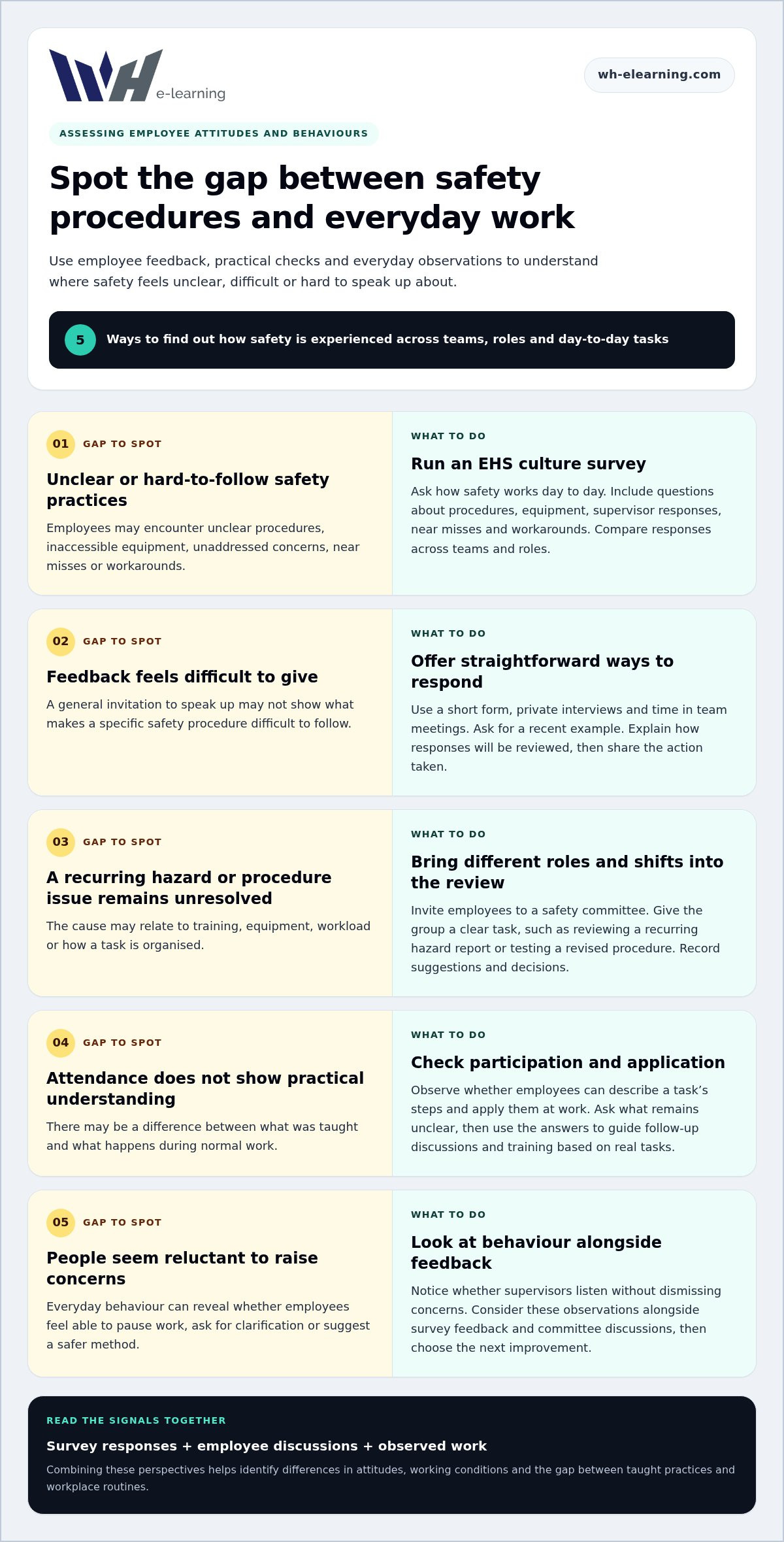
- Use an environment, health and safety (EHS) culture survey to understand how employees experience safety practices day to day. Ask whether procedures are clear, equipment is accessible and supervisors respond to concerns. Include questions about near misses and workarounds, not just incidents. Compare responses across teams and roles to identify differences in attitudes or working conditions. Assessing employee views is a practical first step in creating a positive workplace safety culture.
- Make feedback specific and straightforward to give. Offer a short form, private interviews and time during team meetings for employees to raise concerns. Ask for a recent example, such as a task where a safety procedure was difficult to follow. Explain how responses will be reviewed, then share the action taken so employees can see how their input leads to improvements.
- Invite employees from different roles and shifts to join a safety committee. Give the group a clear task, such as reviewing reports about a recurring hazard or testing whether a revised procedure works in practice. Record suggestions and decisions. This can help distinguish a training gap from an issue with equipment, workload or task organisation.
- Assess safety training through participation and practical application, not attendance alone. Observe whether employees can describe the steps for a task and apply them during normal work. Ask what remains unclear after a session, then use the answers to guide follow-up discussions. Training based on real tasks can reveal gaps between taught practices and workplace routines.
- Look for signs of confidence and engagement in everyday behaviour. Do employees pause work to raise a concern, ask for clarification or suggest a safer method? Do supervisors listen without dismissing the issue? Consider these observations alongside survey feedback and committee discussions. Use the findings to choose the next improvement in creating a positive workplace safety culture, particularly when employees seem reluctant to speak up.
What Is a Positive Safety Culture?
Build safety into everyday decisions through clear procedures, worker involvement and leaders who prioritise safe practices. The UK Government identifies good leadership, worker involvement and good communications as foundations for success; barriers include inconsistent management actions, unclear procedures and limited employee input.
- Make safety part of operational decisions. Review procedures against actual tasks, equipment and working conditions, then address gaps with the people doing the work. For example, if a safe method is difficult to follow during a busy shift, find out why before expecting employees to follow it consistently.
- Give employees a meaningful role in improving safety protocols. Invite workers to discuss practical changes, identify where instructions conflict with daily tasks and help test revised processes. Keep decisions transparent by explaining what changed and why. This prevents safety from becoming a document owned only by managers.
- Remove barriers that discourage safe choices. Check whether teams have the equipment, guidance and time they need to follow procedures. Look for mixed messages, such as praising safe work while rewarding speed alone. These conditions can undermine trust and make it harder for employees to prioritise safety.
Train leaders and provide safety resources
Train managers to recognise risks, explain procedures and respond constructively to concerns. Provide practical resources, such as current guidance and time to discuss safety during team meetings. Check that supervisors can apply the same protocols across shifts, rather than relying on written instructions they haven’t practised.
Demonstrate leadership commitment by example
Ask leaders to follow the same safety protocols they expect employees to follow. They can attend safety meetings, take part in initiatives and pause work when a practice appears unsafe. Watch for contradictions, such as a manager bypassing a procedure under pressure. Consistent actions make a transparent commitment visible in everyday work.
Transparent communication and incident reporting
Use task-relevant safety training, clear communication and accessible reporting channels to help employees raise concerns. Regular briefings and constructive responses make it easier to share hazards and learn from incidents.
-
Establish clear safety communication
Explain safety protocols in plain language and show how they apply to specific tasks. During a briefing, for example, describe the hazard, the safe procedure and who can answer questions. Ask employees to explain the key steps in their own words. This can reveal unclear instructions before they affect work.
Use regular safety briefings to share changes and lessons from incidents. Keep messages consistent across managers and shifts, and make the latest procedures easy to access. Don’t rely on notices alone: employees need a chance to ask questions and discuss how instructions apply to their work.
-
Encourage open communication and participation
Make space for employees to raise concerns and suggest improvements during team discussions. Invite quieter team members to contribute, and respond to suggestions with a clear next step. Psychological safety means team members feel able to take interpersonal risks, supported by trust and mutual respect.
Leaders can strengthen trust by listening without blame and explaining decisions openly. For example, if a proposed change can’t be adopted, explain why and discuss another way to improve safety. Recognising employees who take initiative can reinforce participation and support morale.
-
Report hazards and incidents transparently
Provide a clear channel for reporting hazards, incidents and near misses, including a confidential option. Tell employees what details to include, such as the location, task and immediate risk. Make clear that workers can report concerns without fear of repercussions, and establish a non-retaliation policy.
After a review, share what the organisation learned and which corrective actions will follow. Respond to reports without blame, and look for recurring hazards across reports and complaints. Closing the feedback loop shows employees that their reports matter and helps teams apply lessons to prevent similar problems.
Definition and characteristics of a positive safety culture
A strong safety culture exists when shared values guide everyday choices, not just written policies. Use these steps to check whether safety procedures shape real work across your organisation.
- Connect safety values to daily decisions. Identify a practical example, such as whether a team pauses a task when equipment appears damaged. Compare that response with the organisation’s stated priorities. If production targets consistently outweigh safe choices, the gap signals that safety is not yet embedded in workplace values.
- Make safety part of planning and policy. Include safety considerations when setting operational priorities, changing processes or introducing equipment. For example, before changing a workflow, assess how the new sequence affects hazards and procedures. This makes safety a working criterion for decisions, rather than a separate document employees consult only after problems arise.
- Check that protocols are consistent in practice. Compare the written procedure for a task with the steps employees actually follow. If one team uses a different method, find out whether the procedure is impractical, unclear or outdated. A strong safety culture addresses the mismatch and updates processes where needed, rather than treating paperwork as proof of safe work.
- Keep people at the centre of safety provisions. Review whether employees have the training, equipment and guidance their tasks require. For example, a procedure for handling a substance needs suitable protective equipment and clear instructions. Regular reviews help identify changing work conditions and areas where additional support could improve safe practice.
- Measure progress through meaningful signs, not slogans. Track whether procedures are understood, safety concerns lead to practical changes and employees see leaders follow agreed standards. Increased reporting may reflect greater confidence in raising concerns, so interpret it alongside the nature of reports and actions taken. Use the findings to strengthen values, consistency and accountability.
WH eLearning: Health and Safety Training Courses
WH eLearning offers Health and Safety Training Courses to help organisations build employees’ knowledge alongside practical safety procedures. Its video-based, accredited courses can be accessed on any device and include closed captions. Multi-language Course Translation can support learners who benefit from translated course content.
Choose training that reflects the risks, tasks and procedures employees encounter in their roles. For teams that benefit from direct, in-person learning, WH eLearning’s in-house face-to-face training provides another way to develop relevant workplace knowledge. HR and business compliance courses are also available for wider organisational learning needs.
Use training as one part of a wider approach: leaders still need to model safe practices, listen to employees and act on reported concerns. Contact WH eLearning to discuss training that supports your workplace safety goals.
Make safety part of how work gets done
Trust grows through repeated actions, not a single policy launch. Choose one practical improvement employees can see, such as removing a recurring barrier to safe work or reviewing how a change affects a team. Then make responsibility clear and follow through. Visible progress gives people a reason to keep contributing.
Creating a positive workplace safety culture also depends on knowledge that fits each role. WH eLearning offers comprehensive management safety courses and essential employee safety programmes, alongside its wider health and safety training catalogue. These options can support managers developing their safety responsibilities and employees building workplace safety knowledge.
Take the next step by matching training to your organisation’s needs and the roles your employees perform. Contact WH eLearning to discuss safety training, then keep building trust through consistent action. Every practical step helps make safer work an everyday part of your organisation.
Frequently Asked Questions
What is a positive workplace safety culture?
A positive workplace safety culture is one where safety guides ordinary decisions and employees can raise risks without being dismissed. For example, if a delivery route changes, workers might flag blind corners and help trial a safer layout. Managers can then review whether the adjustment works during routine operations. The culture is visible in those choices, not just in written policy.
What are the key elements of an effective safety culture?
An effective safety culture combines clear expectations, workable procedures, suitable resources and consistent leadership. Consider a maintenance task: workers need instructions that match the equipment, access to the right tools and clarity about when to pause. A useful test is whether these elements still work when conditions change, such as when a task moves to another area or team.
How can leaders demonstrate commitment to workplace safety?
Leaders demonstrate commitment by making safe choices visible, including during busy periods. For instance, a manager can pause a job when a safeguard is missing, arrange for it to be addressed and explain the decision to the team. They can also include safety in operational planning, so deadlines and resource decisions reflect the conditions employees need to work safely.
How can employees be encouraged to report hazards and near misses?
Make reporting straightforward and show employees what happens after a report arrives. A worker should be able to describe a near miss by noting the task, location and contributing conditions. Managers can acknowledge the report, investigate relevant factors and share lessons without exposing personal details. This helps employees see that reports support learning rather than blame.
How should employers measure and improve safety culture?
Use a mix of employee feedback and practical indicators, including training completion and hazard identification reports. Review them alongside inspection findings and corrective actions to see whether known problems are being addressed. For example, repeated reports about the same work area may point to an unresolved process issue. Use the findings to assign improvements and revisit whether they have changed workplace practice.
How can organisations involve workers in safety decisions?
Involve workers before changing equipment, procedures or work layouts, while their practical knowledge can shape the decision. Invite people in affected roles to walk through the proposed change and identify problems a plan may overlook. After a trial, ask what worked and what needs adjustment. Explain how their input influenced the final decision, even when a suggestion wasn’t adopted.


