

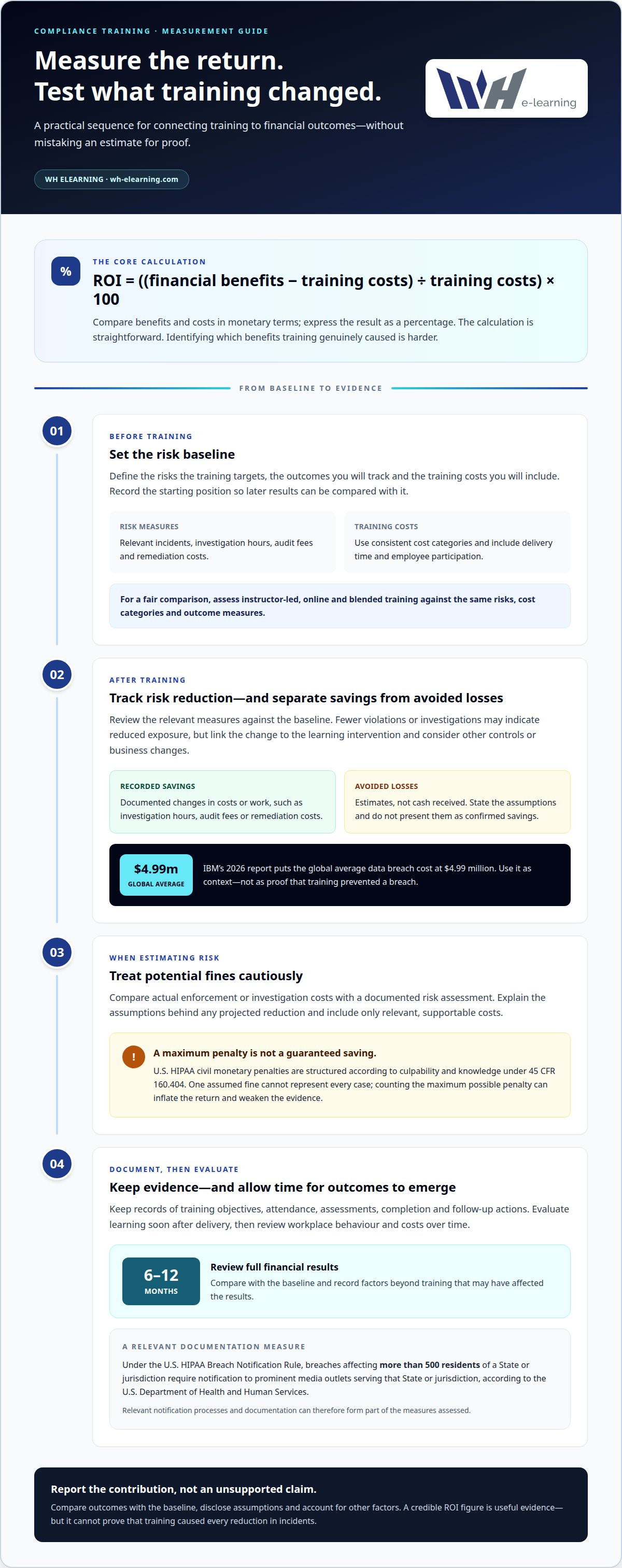
Yes, measuring the ROI of compliance training is possible: subtract training costs from the financial benefits, divide the result by training costs, then multiply by 100. Compare benefits and costs in monetary terms, and express the result as a percentage. The calculation is straightforward; identifying which benefits training genuinely caused is harder.
That challenge is familiar. Fewer incidents or lower costs may indicate progress, but completion figures alone cannot show whether people have learned or changed how they work. A credible assessment links training to specific risks, tracks relevant outcomes and considers other factors that may have influenced the results.
This guide explains how to calculate ROI, why the figure can be difficult to trust and how to assess wider business effects. You’ll learn to set useful measures before training, compare results afterwards and combine financial indicators with evidence of learning and behaviour. The aim is to understand what training contributes, not to claim one number captures every benefit.
Key Takeaways
- Calculate ROI by comparing training’s measurable financial benefits with its costs, then express the result as a percentage.
- Set clear objectives and account for other factors that could affect outcomes before attributing savings or avoided losses to training.
- Look beyond completion rates: assess learning, workplace behaviour and business measures that reflect your organisation’s priorities.
- Combine financial results with employee feedback and other qualitative evidence to build a more complete picture of training’s impact.
Can you calculate ROI on compliance training?
Yes: subtract training costs from measured benefits, divide by costs, then multiply by 100. Compare instructor-led, online and blended training using the same risks, cost categories and outcome measures, including delivery time and employee participation.
-
Measure Risk Reduction and Cost Avoidance
Set a baseline for the risks the training targets, then track relevant incidents, investigation hours, audit fees and remediation costs. Separate recorded savings from avoided losses, which are estimates rather than cash received. IBM’s 2026 report puts the global average data breach cost at $4.99 million. Use that figure as context, not as proof that training prevented a breach.
Record whether changes followed training and consider other controls or business changes. Fewer violations or investigations may indicate reduced exposure, but the evidence should link the change to the learning intervention.
-
Account for Estimated Fine Risks
Estimate avoided fines cautiously. Compare actual enforcement or investigation costs with a documented risk assessment, and explain the assumptions behind any projected reduction. U.S. HIPAA civil monetary penalties are structured according to culpability and knowledge under 45 CFR 160.404, so a single assumed fine cannot represent every case.
Include only relevant, supportable costs, such as investigation work, response activity and audit fees. Don’t count the maximum possible penalty as a guaranteed saving. Doing so can inflate the return and weaken the evidence behind your investment decision.
-
Document Requirements and Evaluate Results
Keep records of training objectives, attendance, assessments, completion and follow-up actions. Under the U.S. HIPAA Breach Notification Rule, breaches affecting more than 500 residents of a State or jurisdiction require notification to prominent media outlets serving that State or jurisdiction, according to the U.S. Department of Health and Human Services. This makes relevant notification processes and documentation important measures.
Evaluate learning soon after delivery, then review workplace behaviour and costs over time. Assess full financial results 6-12 months after training, allowing time for outcomes to emerge. Compare the results with your baseline and record factors beyond training that may have affected them.
Why compliance training ROI is difficult to calculate
Attribution is difficult because incidents can change for reasons beyond training. A calculation or worksheet can organise the evidence, but its result depends on assumptions about risk, behaviour and costs.
- Separate training’s contribution from other changes. New reporting processes, staffing or technology can affect incident rates alongside learning. Compare the same measures before and after training, and record changes that could influence the results. Completion figures alone don’t demonstrate engagement, understanding or changed behaviour, so include assessment results and relevant workplace evidence.
- Use a worksheet to list direct training costs and measurable benefits. The basic ROI calculation is benefits minus costs, divided by costs, then multiplied by 100. Treat the result as an estimate, not proof that training caused every saving.
- Model risk consistently with security terms. Single Loss Expectancy (SLE) estimates loss from one event; Annual Rate of Occurrence (ARO) estimates its annual likelihood. Annual Loss Expectancy (ALE) equals SLE multiplied by ARO. A 20% annual probability is an ARO of 0.20; an event occurring once in ten years corresponds to 0.10 per year.
- Calculate Return on Security Investment (ROSI) by subtracting the programme’s costs and post-training ALE from pre-training ALE, then dividing the difference by programme costs. This helps compare reduced expected losses with investment, but it depends on credible SLE and ARO estimates. A calculator cannot fix weak inputs: review its assumptions, incident records and cost evidence before sharing results with decision-makers.
Even a careful calculation cannot isolate training perfectly when other controls or business conditions change. Report the assumptions and plausible contributing factors instead of claiming every reduction in incidents resulted from the course.
What effect does training have on the business?
Link learning to business priorities, then track outcomes that show whether employee behaviour supports them.
-
Align Metrics with Business Goals
Start with a defined business challenge, such as repeated safety incidents or mishandled customer data. Agree what employees should do differently, then choose a measure that reflects that action. For a data-handling course, track reports of suspicious messages alongside incident records. A completion rate shows participation, not whether the target behaviour changed.
Keep the measure relevant to the goal. If leaders aim to improve reporting, a fall in reports alone may mislead: employees might be reporting less, rather than encountering fewer problems. Compare several indicators and explain what each can and cannot show.
-
Connect Training to Strategic Value
Map each learning objective to an organisational priority, such as safer operations, consistent customer treatment or fewer disruptions. Then identify the pathway between them: employees recognise a risk, take the expected action and help prevent a business problem. This makes the proposed return on investment easier to explain without treating correlation as proof of cause.
Use a business impact study to compare a baseline with later results. For example, assess whether teams that completed targeted training follow a new reporting process more consistently. Record operational changes that could also affect performance, so leaders can judge training’s contribution alongside other factors.
-
Measure Business Outcomes
Combine operational data with employee evidence. Compare incident patterns, audit findings, customer complaints or time spent correcting errors with the training objective. Post-training surveys can test what employees learned and whether they apply it at work. Include scenario-based questions too, such as what action someone would take after receiving a suspicious email.
Use more than completion data: a Deloitte and Compliance Week survey found that 50% of companies use course completion as their primary effectiveness measure. Treat completion as a starting point, then add behaviour and business outcomes. Review the evidence with managers who see the work directly, and note where results differ between teams.
Measuring compliance-training ROI
Build a measurement plan linking course learning to workplace behaviour and business results. Use several indicators, since no single figure can capture every effect.
- Set a baseline before each initiative begins. Record the target behaviour, relevant incidents, time spent correcting errors and training delivery costs. Choose measures that match the course, such as whether employees follow the correct reporting steps in a conduct scenario. This gives you a point of comparison and makes later changes easier to interpret.
- Check learning and behaviour separately. Use assessment results to see whether employees understand key material, then observe whether they apply it at work. Review behaviour changes 1-3 months after training, using manager observations, scenario questions or work records. Course completion is useful for tracking participation, but it cannot by itself show learning or prove changed practice.
- Translate relevant outcomes into business measures. Track investigation workload, time spent resolving issues, errors corrected and employee hours returned to other work. One global medical technology company saved 16,469 hours of compliance-training seat time in one year. Treat that as an example of a measurable operational outcome, not a forecast for another organisation.
- Combine financial and qualitative evidence before reporting ROI. Review cost records alongside employee feedback, assessment results and workplace indicators. Check for unintended signals: fewer reported harassment incidents might reflect fear of retaliation rather than less misconduct. Revisit assumptions and key performance indicators regularly, and explain which results are observed, estimated or difficult to attribute solely to learning.
Make your next learning initiative easier to assess by planning measurable training initiatives around clear workplace outcomes.
WH eLearning: Health and Safety Training Courses
WH eLearning offers Health and Safety Training Courses and HR and Business Compliance Courses for organisations developing practical workplace learning. Choose a relevant course when your assessment identifies knowledge or behaviour gaps, then track participation, learning and workplace outcomes against your objectives.
For teams that benefit from direct instruction, In-House Face-to-Face Training offers another learning format. Multi-language Course Translation can help make course content accessible to employees who use different languages. These options can support a training plan shaped around your workforce and the risks it needs to address.
Contact WH eLearning to discuss training suited to your organisation’s learning needs.
Make your next training decision count
Turn your next compliance priority into a focused learning initiative. Before choosing a course, identify the workplace capability your team needs to strengthen and decide who will review its impact. This makes evaluation part of the decision from the outset, rather than an exercise added afterwards. A thoughtful approach to measuring the ROI of compliance training can help you decide what to refine, reinforce or prioritise next.
Where workplace safety is a priority, WH eLearning offers Health and Safety Training Courses. Choose learning that addresses your identified needs, then use your evaluation approach to guide future training decisions.
Contact WH eLearning to discuss training for your organisation. Each clear next step helps build a more considered approach to workplace learning.
Frequently Asked Questions
Does this mean training spend cannot be justified?
No. A precise financial return isn’t the only basis for a training decision. Consider whether employees need the knowledge to perform their roles safely, follow internal processes or manage identified risks. A business case can combine learner assessments, manager observations and operational priorities. For example, if staff repeatedly miss a required reporting step, targeted learning may address a clear capability gap even before financial savings can be demonstrated.
Is there evidence that compliance cost-benefit forecasts are unreliable?
Forecasts can be uncertain because they depend on assumptions about how often incidents occur, their consequences and training’s contribution. That does not make every forecast unreliable; it means readers need to see how it was developed. Separate observed results from projections, record the assumptions and test how the estimate changes when those assumptions shift. This gives decision-makers a clearer view of confidence and uncertainty.
What Counts as Training Costs?
Include direct and indirect costs over the same measurement period. Direct costs can include course access, content development, instructor time and assessment materials. Indirect costs may include employees’ time away from usual duties, administration, scheduling and follow-up. For example, a team session involves both delivery time and the hours learners spend attending. Record each category consistently so comparisons between initiatives remain meaningful.
What should be measured instead?
Measure whether people can apply the expected action in their role. A data-handling course, for instance, could be assessed using scenario responses, manager observations and the quality of escalation records. Pair these with indicators linked to the original business objective, such as fewer repeated process errors. Employee feedback can also reveal whether instructions were clear and practical. Together, these measures show more than attendance alone.
Why not use avoided fines?
A fine that did not occur is difficult to verify as a saving caused by training. Enforcement outcomes depend on factors beyond course participation, so treating a hypothetical penalty as guaranteed value can overstate results. Use documented costs your organisation actually incurred, such as investigation or corrective work, where relevant. Present potential fine avoidance separately as a risk scenario, making its assumptions clear.
How do you calculate the ROI of compliance training?
For measuring the ROI of compliance training, subtract total training costs from attributable financial benefits, divide that result by total costs, then multiply by 100. Keep the period and cost categories consistent, and include only benefits supported by records or clearly labelled estimates. For example, use a spreadsheet to show each input separately, allowing reviewers to trace the calculation and challenge assumptions without losing sight of the result.


