

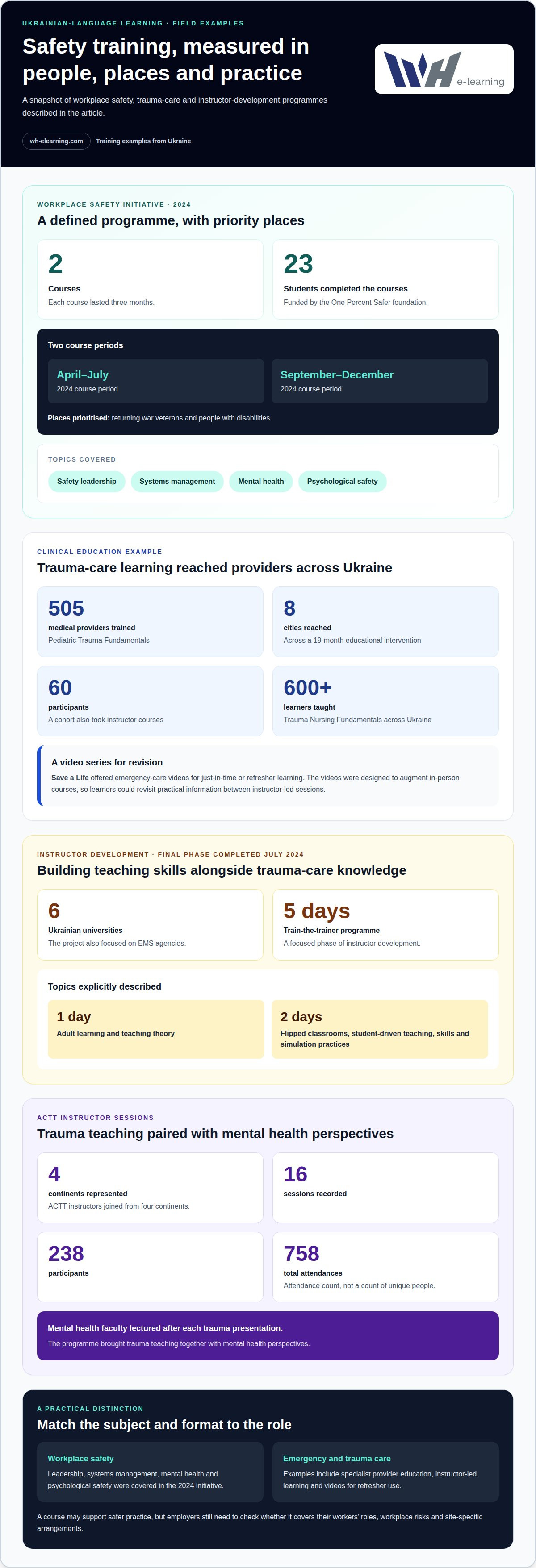
What should Ukrainian health and safety training online cover to be useful at work? Examples from Ukraine include safety leadership, systems management, mental health and psychological safety. In 2024, a Ukraine training initiative included two courses, each lasting three months, with places prioritised for returning war veterans and people with disabilities.
It’s understandable to want more than a course title when planning employee training. You need to know whether the content suits people’s roles and how they can access it. This guide explores examples of online safety and security e-learning, explains the topics training can cover and outlines ways to make learning accessible to your team.
You’ll also find practical points to consider when arranging training, including how language support and learning format shape the experience. Use them to understand your options and identify a suitable next step for your employees.
Key Takeaways
- Understand how online training access can be arranged for employees and what to consider when planning delivery.
- Explore the safety topics Ukrainian-language courses may cover and how to match learning to workplace needs.
- See which factors shape course costs, so you can plan training without relying on assumed price ranges.
- Learn how subtitles, narration and translated materials can support learners, and where WH eLearning’s training options fit.
Training availability and access
For online enrolment, employers provide a learner list, preferred language and course requirements. The provider arranges access and explains how learners can get started. Employers can track completion through learner records or progress reports, where available. Before enrolment, agree what evidence managers need, such as a completion record.
Situation: a Ukraine initiative offered structured safety learning. Action: it ran two courses, each lasting three months. The courses ran from April to July and September to December 2024. The One Percent Safer foundation funded 23 students, who completed the courses. Places prioritised returning war veterans and people with disabilities. Result: students completed a defined programme, rather than receiving only informal safety information.
The certificate depends on the course and provider. A completion certificate can record which course a learner finished, but it does not establish that every employer will accept it. Assess relevance against the worker’s role, training objectives and internal requirements. Before enrolment, identify any qualification or accreditation named for the course and what evidence it provides.
To choose a suitable provider, review the course outline, assessment approach and accreditation details. Check that the course covers the intended workplace risks and is delivered in a language employees understand. Establish how learner identities and completion records are handled, too. These checks help you judge whether training suits the job, not just whether it is online.
The 2024 Ukraine training course covered safety leadership, systems management, mental health and psychological safety. Those subjects can support safer workplace practices, but they don’t identify every site-specific hazard or emergency response. Employers should match course content to their setting. For example, a site may need learning on its own evacuation arrangements, equipment or hazardous materials. A course outline helps show whether those subjects are included.
What online health and safety training courses are available in Ukrainian?
Training examples range from workplace safety to specialist emergency-care learning. The right content depends on employees’ roles and the risks they face. Ukrainian-language examples include trauma-care education, emergency response and refresher videos. Some programmes combine online resources with instructor-led teaching.
Situation: medical providers needed practical trauma-care education across Ukraine. Action: Pediatric Trauma Fundamentals trained 505 medical providers across eight cities during a 19-month educational intervention. A cohort of 60 participants also took instructor courses. Result: the programme developed trauma-care learning and instructor capacity across several locations.
Situation: nurses needed focused trauma-care instruction. Action: Trauma Nursing Fundamentals was taught to over 600 learners across Ukraine. Separately, the Save a Life video series offered emergency-care content for just-in-time or refresher learning. Its videos were designed to augment in-person courses. Result: workers could revisit practical information between instructor-led sessions.
Those examples show why course format matters. A video can support revision, whilst skills practice may need direct instruction. In the final phase, completed in July 2024, a trauma-care project focused on six Ukrainian universities and EMS agencies. Its train-the-trainer programme lasted five days. One day covered adult learning and teaching theory. Two days covered flipped classrooms, student-driven teaching, skills and simulation practices.
Situation: trauma-care education also needed broad instructor participation. Action: ACTT instructors joined from four continents. Its 16 sessions recorded 238 participants and 758 total attendances. Mental health faculty lectured after each trauma presentation. Result: the programme paired trauma teaching with mental health perspectives. Together, these examples help employers distinguish general safety learning, emergency-care content and specialist clinical training. Match the subject and learning format to the employee’s actual role, rather than treating every course as interchangeable.
Ukrainian-language training can cover workplace safety and emergency-care topics, including trauma care and emergency response. Refresher videos let workers revisit practical information between instructor-led sessions.
How much do online Ukrainian health and safety training courses cost?
The cost of online Ukrainian safety training depends on the course and delivery, not language alone. A short awareness course and a specialist programme have different development needs. Pricing may also reflect whether Ukrainian content already exists or needs translation. A course using existing materials, for example, may require different preparation from one adapted for a specific workplace.
Start by defining the training need. A warehouse team might need learning on handling risks and emergency procedures, while office staff may need different topics. The course scope affects the work required to prepare or select suitable content. A clear outline helps establish the subject, language support and assessment needs before pricing.
Delivery format matters, too. Self-paced online learning differs from a programme with instructor-led sessions or tailored materials. Assessment, learner access and completion reporting can also affect the package. Ask for these elements to be itemised in a written quote, so you can see what the proposed price covers.
Illustrative planning example: An employer needs Ukrainian-language safety learning for employees in different roles. First, the provider identifies the relevant topics and learner groups. Then the employer decides whether existing course content is suitable or needs adaptation. The quote reflects the agreed scope, rather than an assumed standard price for every Ukrainian-language course.
Compare proposals on a like-for-like basis. Check the included course topics, language format, assessment, learner access and completion evidence. If one proposal includes translated materials and another does not, they cover different work. The same applies to tailored content or live teaching. A written breakdown clarifies the cost drivers and helps you choose a package aligned with workplace risks.
For Ukrainian health and safety training online, start by specifying employee roles, required topics and preferred learning format. These details give a provider a clear basis for pricing. Avoid relying on broad market averages: course scope, translation requirements and delivery choices determine what a quote covers.
Do online safety training providers offer Ukrainian subtitles, narration, or translated materials?
Yes, Ukrainian-language access can take different forms. Subtitles show translated text alongside spoken instruction. Ukrainian narration provides spoken translation, while translated materials offer written guidance separately. These options suit different learning preferences, so identify which format works for your employees and the course content.
For example, video-based learning can pair closed captions with machine translation into more than 25 languages. Captions let learners read alongside a video, while translated text can make course information easier to follow. Machine translation is a distinct format from professionally recorded Ukrainian narration. Employers should note which option a course actually provides.
Situation: a worker understands spoken Ukrainian more easily than written English. Action: Ukrainian narration can deliver instructions aloud, while subtitles provide a visual reference. Result: the learner can follow the lesson in a suitable language format. If employees prefer reading, translated handouts can support review after the video. Choose a format that fits both learner needs and the material being taught.
Safety terms need particular care. A translated phrase about protective equipment, evacuation or incident reporting must communicate the intended action clearly. Review the course outline for relevant examples, then consider how key instructions appear in each language format. Subtitles can help with general explanations, while written supporting materials make detailed steps easier to revisit.
For a practical decision, first identify your workforce’s preferred language format. Then match it to the course’s subtitles, narration or translated resources. Finally, consider the lesson itself: a video demonstration, written procedure and spoken explanation serve different purposes. This helps you choose training employees can follow, rather than relying on a language label alone.
To explore online learning with language-access features, view Ukrainian-language training options and consider which format best supports your team.
The Washington State Department of Health links to vaccination coverage and record translation guidance for healthcare providers serving Ukrainian newcomers from the Center for Excellence in Newcomer Health: Minnesota. It also lists a recording of a Ukrainian vaccination records webinar, along with slides and a transcript, and a Ukrainian and Russian language translation guide for school immunisation records from Spokane Regional Health District.
WH eLearning: Health and Safety Training Courses
WH eLearning offers Health and Safety Training Courses for organisations planning employee learning. Its video-based courses are accredited, work on any device and include closed captions. Employees can fit learning around their work, while HR and Business Compliance Courses address related workplace learning needs.
Where language access is a priority, Multi-language Course Translation can support course delivery across languages. In-House Face-to-Face Training is another option when a workplace needs instructor-led learning rather than an online format. The right route depends on employees’ roles, course topics and preferred learning method.
If you’re planning safety training for Ukrainian-speaking employees, contact WH eLearning to discuss your training needs and suitable options.
Plan a confident next step for your team
Choosing Ukrainian health and safety training online starts with a practical question: which skills should employees use more confidently in their roles? Make that the focus of your next training discussion. It keeps course selection connected to workplace needs and gives managers a clear basis for planning learning.
For broader workforce training, WH eLearning offers comprehensive online safety modules and health and safety training courses. These give organisations different routes to consider when shaping a programme. The best fit depends on learning objectives, employee roles and the format your team can access effectively.
Use your preferred language, course topics and delivery format as starting points for a focused conversation. This turns general interest into a clear training plan without assuming one course suits every role.
Contact WH eLearning about training to discuss the needs of your employees and explore a suitable next step. A considered plan can help your team build relevant knowledge and move forward with confidence.
Frequently Asked Questions
Are online Ukrainian safety courses self-paced, instructor-led, or available on mobile devices?
Courses can use different formats, depending on the provider and course. WH eLearning’s IOSH Online Courses are self-paced, while its In-House courses are face-to-face. Online learning can also suit employees using mobile devices: WH eLearning courses work on mobile, tablet and desktop devices and include closed captions. Employers can choose a format around shift patterns, learner preferences and whether practical instruction is needed.
Are free online health and safety training resources available in Ukrainian?
Free educational materials may be available, but their scope and format vary. A video or guidance document can introduce a topic or refresh existing knowledge. Before relying on it for workplace training, consider whether it covers the relevant task, explains actions clearly in Ukrainian and provides a way to record completion. Employers who need structured learning may prefer a course with defined content and assessment.


