

What if assessing health and safety competence in the workplace started with what a worker can do, rather than what’s in their training file? Certificates and course records are useful, but they don’t always show how someone applies their knowledge during real tasks or responds to changing risks.
It’s understandable to want a consistent way to judge whether people can work safely, especially when roles and hazards differ. A fair assessment looks at the knowledge, skills and experience needed for each role, then gathers evidence of how well a person meets those requirements in practice.
This guide explains how to match assessment methods to the task and level of risk, record findings clearly, and decide what support is needed when you identify a gap. It also covers planning reassessments and development, using training to build knowledge alongside practical assessment and supervision. With a structured approach, competence decisions can be clearer, more consistent and focused on helping people work safely.
Key Takeaways
- Assessing health and safety competence in the workplace means checking whether a person can apply relevant knowledge, practical skills and judgement to their actual tasks.
- Start with the work and its conditions, then use a clear sequence to gather evidence, make an assessment and agree next steps.
- Choose methods such as observation, practical demonstration, structured questions and record review to suit the task. No single method proves competence on its own.
- Keep records that capture the assessment criteria, evidence, outcome and agreed review point, and give feedback based on observable strengths and gaps.
- Use relevant learning to build knowledge and support development, while keeping practical assessment and supervision part of the competence process.
What does assessing health and safety competence in the workplace mean?
Learning how a task should be done is not the same as being able to do it safely at work. Assessing health and safety competence in the workplace means evaluating whether someone has the relevant knowledge, practical skills, experience and judgement to carry out the duties of a particular role safely and effectively.
In brief, competence is a person’s demonstrated ability to perform a specific task safely, using suitable knowledge, skills, experience and judgement in the conditions where the work takes place. It’s task-related, not a permanent label attached to a worker. Someone may be competent for familiar duties but need further support when equipment, procedures or working conditions change.
What evidence makes a worker competent for a task?
Use evidence that connects directly to the work, rather than relying on a general impression. A worker’s understanding of a procedure matters, but so does their ability to follow it while handling the equipment, materials and conditions involved.
- Task knowledge: Can the worker explain the relevant steps, hazards and controls?
- Observed performance: Can they carry out the task safely and follow the required procedure?
- Relevant experience: Have they performed comparable work, and how recent and applicable is that experience?
- Judgement: Can they recognise when conditions differ from what they expect and respond appropriately?
For example, someone may correctly describe a workplace procedure during a discussion. Watching them follow it in the work area can show whether they can apply that knowledge in real conditions. A course completion record is evidence of learning; observation or a practical demonstration shows how that learning is used. Neither has to stand alone: the assessor can bring together different evidence to form a clearer picture.
Why assess competence beyond checking certificates?
A certificate can show that a person completed training or met a course’s requirements. It doesn’t, by itself, establish how well they perform a particular task at your workplace, whether their knowledge is still current, or how they respond to conditions that differ from a training setting.
Experience is valuable, but it should be considered against today’s task requirements. A worker may have performed similar duties for years, yet need an update if a procedure or piece of equipment has changed. Equally, a new worker may demonstrate the required ability through suitable instruction and practical assessment, even if their experience is limited.
Set the assessment to match the role and task. The evidence needed for a routine, familiar activity may differ from what’s appropriate for complex work with more demanding conditions. The aim isn’t to give everyone the same test or require the same qualification. It’s to reach a fair, evidence-based view of whether each person can perform their assigned work safely.
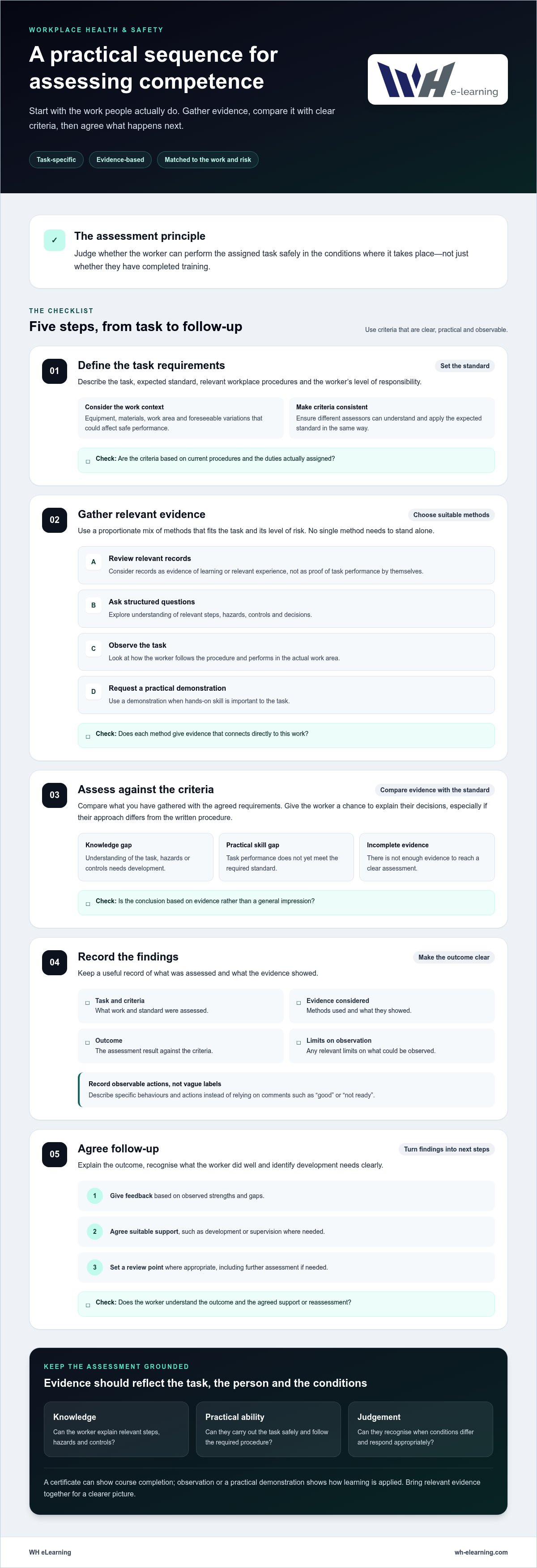
How to assess health and safety competence: a practical sequence
A reliable assessment starts with the work, not a standard form. Identify the task, the conditions in which it’s carried out and what safe performance looks like. Then choose evidence that can show whether the worker meets that standard. A brief conversation may help assess understanding; a practical demonstration or observation may be more suitable for a hands-on task.
Assess competence against the work people actually do, in the conditions they do it.
- Define the task requirements. Specify the task, expected standard, relevant workplace procedures and the worker’s level of responsibility. Consider equipment, materials, the work area and foreseeable variations that could affect safe performance. Make the criteria clear enough for different assessors to apply them consistently.
- Gather relevant evidence. Select a proportionate mix of methods, such as reviewing relevant records, asking structured questions, observing the task or asking the worker to demonstrate a skill. Choose methods that fit the risk and nature of the work, rather than relying on a generic checklist.
- Assess against the criteria. Compare the evidence with the agreed standard. Give the worker a chance to explain their decisions, especially if their approach differs from the written procedure. Distinguish between a knowledge gap, a practical skill gap and a situation where the evidence is incomplete.
- Record the findings. Note the task and criteria assessed, evidence considered, outcome and any limits on what you could observe. Record specific behaviours and actions rather than vague judgements such as “good” or “not ready”.
- Agree follow-up. Explain the outcome, recognise what the worker did well and identify any development needed. Agree suitable support, supervision or further assessment, with a review point where appropriate.
Set clear, role-specific assessment criteria
Before the assessment, check that the criteria reflect current workplace procedures and the actual duties assigned to the worker. For example, criteria for using equipment might cover pre-use checks, correct operation and the response expected if something is wrong. Keep the standard practical and observable, and make sure both worker and assessor understand it. Where legal or regulatory requirements apply, verify them against current authoritative guidance before relying on them.
Terminology can vary across jurisdictions. For comparison, the OSHA definition of 'competent person' is set out in a US construction regulation; it isn’t a substitute for requirements that apply in the UK.
Gather and evaluate evidence fairly
Brief the worker on the task, criteria and assessment method before starting. This helps them understand what’s being assessed and reduces surprises. Apply the same relevant criteria to workers doing comparable tasks, while adapting the method to the work. If conditions prevent a fair observation, record that limitation and arrange a suitable opportunity to complete the assessment rather than drawing an unsupported conclusion.
Training can help build knowledge that an assessment identifies as a gap. WH eLearning’s health and safety training courses can support that development alongside practical assessment and supervision.
Which competence assessment methods suit different workplace tasks?
Choose methods that reveal what the worker needs to know and do, not simply what information they can recall. A familiar, straightforward task may need a focused discussion and a review of relevant training records. A complex task, or one affected by changing conditions, may call for observation or a planned practical demonstration as well. When assessing health and safety competence in the workplace, combine evidence if a single method would leave important questions unanswered.
| Method | What it can reveal | What it cannot establish alone |
|---|---|---|
| Observation | How a worker follows steps, uses equipment and responds during normal work. | Why they made a decision, or whether one observed performance reflects every condition. |
| Practical demonstration | Whether a worker can perform a defined task or skill in a planned setting. | How consistently they perform during routine work or unexpected changes. |
| Structured questions | Understanding of procedures, hazards, decisions and responses to changed circumstances. | Whether the worker can apply that knowledge skilfully in practice. |
| Record review | Relevant training, qualifications, previous assessments or work history. | Current ability to perform the task safely in the workplace. |
Method choice should reflect the work’s complexity, the worker’s familiarity with it and any recent changes to procedures or conditions. A less experienced worker may need more direct practical evidence, while records of relevant experience can help an assessor decide where to focus. If working conditions have changed, previous evidence may not address the new demands. No qualification, interview or digital record is a complete substitute for evidence that relates to the task.
When should an assessor observe or request a practical demonstration?
Observe when safe performance depends on actions, sequence or interaction with equipment. A planned demonstration can be useful if the task is infrequent or can’t be observed during ordinary work. Set it up so the worker can show the required skill without introducing hazards or interrupting others. Don’t ask someone to repeat an unsafe act to prove a point; assess against an appropriate, controlled task and record what was actually demonstrated.
How can questions and records support the assessment?
Use open questions that invite the worker to explain their reasoning: “What would you do if the conditions changed?” or “How would you recognise that this step couldn’t be completed as planned?” Answers can show whether they understand procedures and can make relevant decisions, but confidence in an interview isn’t proof of practical ability. Training and qualifications provide useful context. They should support, not replace, task-related evidence.
The NIOSH review Effectiveness of OHS Training examines evidence on occupational health and safety training. Use learning to build knowledge, then assess how it transfers to the task through suitable practical evidence. Together, these methods give a fuller view than any one source alone.
How to document competence gaps, feedback and reassessment
A useful assessment record turns a decision into a clear next step. It should show what was assessed, what evidence informed the outcome, what the worker does well and where further support is needed. In assessing health and safety competence in the workplace, good documentation helps managers and workers understand the decision and follow up consistently.
A useful competence record captures the task and criteria, assessment date and assessor, evidence reviewed, outcome, agreed actions, responsibility for follow-up and a suitable review point.
What should a competence assessment record include?
Keep the record proportionate to the task and consistent with your organisation’s processes. Include enough detail for someone else to understand what happened and why the decision was reached. Avoid broad labels such as “incompetent” without describing the specific evidence behind the conclusion.
- Assessment details: the task, relevant criteria, date, assessor and method used.
- Evidence and outcome: what was observed, discussed or reviewed, the decision reached, and any limits on the assessment.
- Development plan: the gap identified, agreed action, person responsible and review point.
Make feedback factual and balanced. For example, “completed the equipment check in the correct sequence” recognises an observed strength. “Didn’t identify the change that required the procedure to stop” describes a specific gap that can be addressed. Give the worker time to respond, clarify anything they believe the assessment missed and agree what support would help.
Match development to the gap
Choose an action that addresses the issue identified, rather than defaulting to a full course for every shortfall. A knowledge gap may call for instruction or refresher learning. If the worker understands the procedure but needs more confidence carrying it out, supervised practice may be more appropriate. Where evidence was incomplete, arrange a further assessment using a suitable method. Make the action clear enough that both parties know what improvement will look like.
When should competence be reviewed or reassessed?
Set a review point that fits the task and the circumstances, rather than applying an arbitrary interval to every role. Reassess when equipment, procedures, task requirements or working conditions change, or when a performance concern raises a relevant question about current ability. A review is also useful if existing evidence no longer reflects the work being done.
At follow-up, check whether the agreed development took place and gather evidence against the relevant criteria. If the worker now meets the standard, record the outcome and any ongoing support needed. If a gap remains, explain what is still required and agree a proportionate next step. This keeps assessment focused on development as well as decision-making.
Targeted learning can support a knowledge gap before follow-up assessment. Explore health and safety training courses to help workers build relevant knowledge alongside practical development and supervision.
How WH eLearning can support workplace competence development
Assessment shows what a worker can do now and where more support may help. Training can build or refresh the knowledge behind safe work, but completing a course doesn't by itself demonstrate that someone can apply what they've learned during a specific task. Use learning as one part of a broader approach, alongside practical assessment, supervision and follow-up.
WH eLearning's online library contains over 100 titles, accessible on any device. All courses include closed captions and are available in 25+ languages, with machine translation into supported languages. These features can help organisations make relevant learning accessible to workers with different language and learning needs.
Match learning and support to the identified competence gap
Start with the finding, then choose a development action that addresses it. If a worker needs to strengthen their understanding of a procedure, relevant online learning can support that knowledge development before a suitable follow-up assessment. If they understand the steps but need to apply them more reliably, pair learning with practical instruction or supervised practice. Reassess against the task criteria to see whether the gap has closed.
For broader learning needs, WH eLearning's fully approved and certified online health and safety courses can be completed in learners' own time and at their own pace. Specialist-led in-house training combines theory with practical skills, helping organisations connect learning with workplace activities. The appropriate option depends on the identified gap and the work the learner needs to carry out.
Turn assessment findings into a practical development plan
Keep the process simple and connected:
- Assess: identify what the worker can demonstrate against the relevant task criteria.
- Identify a gap: describe the knowledge or skill that needs development, using clear, observable detail.
- Develop capability: select suitable learning, instruction, practical experience or supervision.
- Review evidence: reassess the relevant task and record whether the worker now meets the expected standard.
This cycle makes training purposeful. It also helps managers avoid assigning learning that doesn't address the issue or treating course completion as proof of practical ability. Keep the agreed action and review point clear, and adjust the plan if the follow-up assessment shows that further development is needed.
For organisations shaping wider health, safety and training plans, WH eLearning consultancy can support those needs. A structured development approach makes assessing health and safety competence in the workplace more than a one-off check: it links assessment findings to relevant learning and then back to evidence of performance.
Explore relevant health and safety courses and training support to help turn assessment findings into practical development for your workforce.
Make competence development part of everyday work
Use each assessment as a starting point for an ongoing conversation about safe, effective work. Invite workers to raise concerns when tasks or conditions change, and make it straightforward for them to ask for guidance before a small uncertainty becomes a larger gap. This helps build shared responsibility for keeping skills relevant, rather than treating competence as a box to tick once.
As you refine your approach to assessing health and safety competence in the workplace, focus on practical progress: identify the next learning need, support the worker to address it, then use suitable evidence to guide the next decision. A clear development plan can help managers connect individual growth with the needs of the wider organisation.
Explore WH eLearning courses and training support to find learning options that can complement your assessment process and support workplace development. With the right mix of guidance, learning and follow-up, you can help people build confidence and keep moving towards safer work.
Frequently Asked Questions
What is a health and safety competence assessment?
A health and safety competence assessment checks whether someone can meet the safety requirements of a particular work task. It considers how the person applies relevant knowledge and skills, not just what training they’ve completed. For example, assessing health and safety competence in the workplace might involve checking whether a worker can follow the correct process when a routine job is interrupted or conditions change.
How do you assess a worker’s competence in the workplace?
Start by identifying the work to be assessed and what acceptable performance looks like. Choose evidence that fits the task, such as watching routine work, asking the worker to explain a decision or reviewing relevant records. For a task involving several steps, note which steps were completed as expected and where help was needed. Share the findings with the worker and agree what happens next.
Is a training certificate enough to prove workplace competence?
No. A certificate can show that a person completed a course or assessment, but it doesn’t necessarily demonstrate how they perform a specific task in your workplace. Use it as supporting evidence, then consider whether the worker can apply the learning to the equipment, procedures and conditions they encounter. If a role has specific qualification requirements, include those when setting the assessment criteria.
Can an experienced worker be assessed without taking another course?
Yes. A course isn’t automatically needed if the worker can show the required knowledge and ability through relevant evidence. An assessor might observe the task, discuss how the worker would handle a less familiar situation, and consider their work history. If the assessment identifies a gap, choose development that addresses it. That could mean guided practice or targeted instruction rather than repeating learning the worker already understands.
Who should assess health and safety competence at work?
The assessor should understand the task, its expected safe standard and the evidence needed to judge performance. This could be a suitably experienced supervisor, manager or relevant specialist, depending on the work. An assessor shouldn’t make a decision beyond their own understanding of the task. For complex or unfamiliar work, involving someone with the relevant technical knowledge can help make the assessment more reliable.
When should an employer reassess a worker’s competence?
Reassess when there’s a reason to question whether existing evidence still reflects the work. For instance, a new process, changed equipment or altered work area may affect how a task is carried out. A performance concern or a return to a task after a lengthy absence may also prompt a review. Set timing according to the task and circumstances, rather than using one interval for every role.
What should be included in a competence assessment record?
Record enough detail for another manager to understand the assessment and its outcome. Include the task, criteria, date, assessor, method, evidence considered and decision. If further action is needed, note what was agreed, who will take responsibility and when the worker’s progress will be reviewed. For example, specify the task step to practise and the evidence that will show whether the required standard has been reached.


