

A safety champion should turn everyday observations into team action, not take responsibility for the whole workplace. Yet the safety champion roles and responsibilities can feel unclear: what belongs in the day-to-day role, and does raising a concern make you personally accountable for fixing it?
Clear boundaries matter, especially when colleagues or managers don’t act straight away. A champion can lead by example, encourage safer behaviour and help concerns reach the right people. Formal accountability remains with those who hold the relevant duties and authority.
This guide explains what a safety champion can do, where the role begins and ends, and how it differs from a formal health and safety representative. It also covers practical ways to raise concerns, track follow-up and encourage constructive conversations. With clear support from managers and relevant learning, champions can help build a safer workplace without being expected to do it all themselves.
Key Takeaways
- Set a clear remit before assigning champion tasks, so everyone knows how the role fits existing workplace arrangements.
- Use the safety champion roles and responsibilities to turn everyday observations into constructive conversations and shared learning.
- Understand how a champion’s contribution differs from management decisions and specialist advice.
- Use a simple routine for listening, recording concerns and tracking progress through existing procedures.
- Match health and safety learning to workplace risks, the champion’s remit and visible management support.
What Is a Safety Champion? Define the Role Before Assigning Responsibilities
A safety champion is an employee who helps colleagues notice, discuss and improve everyday safety. They bring attention to what’s happening at work and help useful observations reach the people and processes that can respond. The role is practical and people-focused: it can make safety conversations easier to start and help teams share feedback with managers.
Organisations may use champions to strengthen local awareness and create a clearer feedback loop between employees and managers. A colleague may feel more comfortable mentioning a recurring issue to someone they work alongside. The champion can then raise it through the agreed route, so it doesn’t remain an informal conversation with no clear next step. This supports the broader practice of Occupational Safety and Health and fits within the workplace’s existing arrangements.
Before assigning safety champion roles and responsibilities, define what the role is and what it isn’t. “Safety champion” is not automatically a job title, a statutory appointment or a promise of decision-making authority. The scope depends on the organisation’s arrangements. Champions support those arrangements; they don’t replace managers, competent specialists or established reporting processes. Clear expectations help everyone understand who makes decisions and who handles specialist matters.
What makes someone a suitable safety champion?
Look for someone who is curious about how work gets done, reliable in following through and able to communicate clearly. A good champion listens without dismissing concerns, asks sensible questions and shares relevant information constructively. They don’t need a particular job title: people in different roles and at different levels may bring useful insight into their team’s day-to-day work. Enthusiasm helps, but it doesn’t replace relevant instruction, clear guidance and organisational support.
Where does the champion role fit in a workplace?
A champion can connect colleagues with managers and established safety processes, helping information travel in both directions. The scope should reflect the team, its working environment and the procedures already in place. For example, if colleagues repeatedly find equipment or materials left in a walkway, the champion can listen, note the pattern and pass the concern to the agreed contact. They can then follow the existing process for updates rather than creating a separate reporting route.
That connection works best when the organisation makes the route clear: who receives concerns, how to raise them and how the champion can share updates with colleagues. A defined remit also helps employees know when to speak to the champion and when to use another established channel. With those basics in place, champions can encourage timely, practical conversations without becoming the sole owner of every safety matter.
Safety Champion Roles and Responsibilities in Everyday Work
Useful safety champion roles and responsibilities involve specific, visible actions. A champion isn’t expected to prevent every incident or resolve every concern alone. Their contribution is to notice patterns, encourage practical conversations and help information move through the organisation’s established processes.
In everyday work, this can mean modelling agreed safe behaviours, sharing relevant reminders and asking colleagues what makes a task harder to do safely. It may also involve passing on updates from managers or safety specialists through the channels the organisation already uses. Champions shouldn’t create new rules or present personal opinions as official guidance.
A safety champion helps good safety information travel, but doesn’t take over decisions or responsibilities outside their remit.
How champions encourage safer everyday behaviour
Leading by example gives reminders weight. If a colleague is about to leave materials in a walkway, a champion might say, “Could we move those to the agreed storage area? They’re narrowing the route.” This is specific and respectful, unlike blame or a vague instruction to “be more careful”. The aim is to explain the expected behaviour and encourage a constructive response.
Short conversations can reveal why a concern keeps coming up. A champion might ask during a team check-in whether the storage arrangement is working, then pass on a practical suggestion through the usual channel. Keep discussions relevant to the team’s work and existing procedures. If a question needs technical advice or a management decision, direct it to the appropriate person rather than guessing.
How champions raise concerns and support follow-up
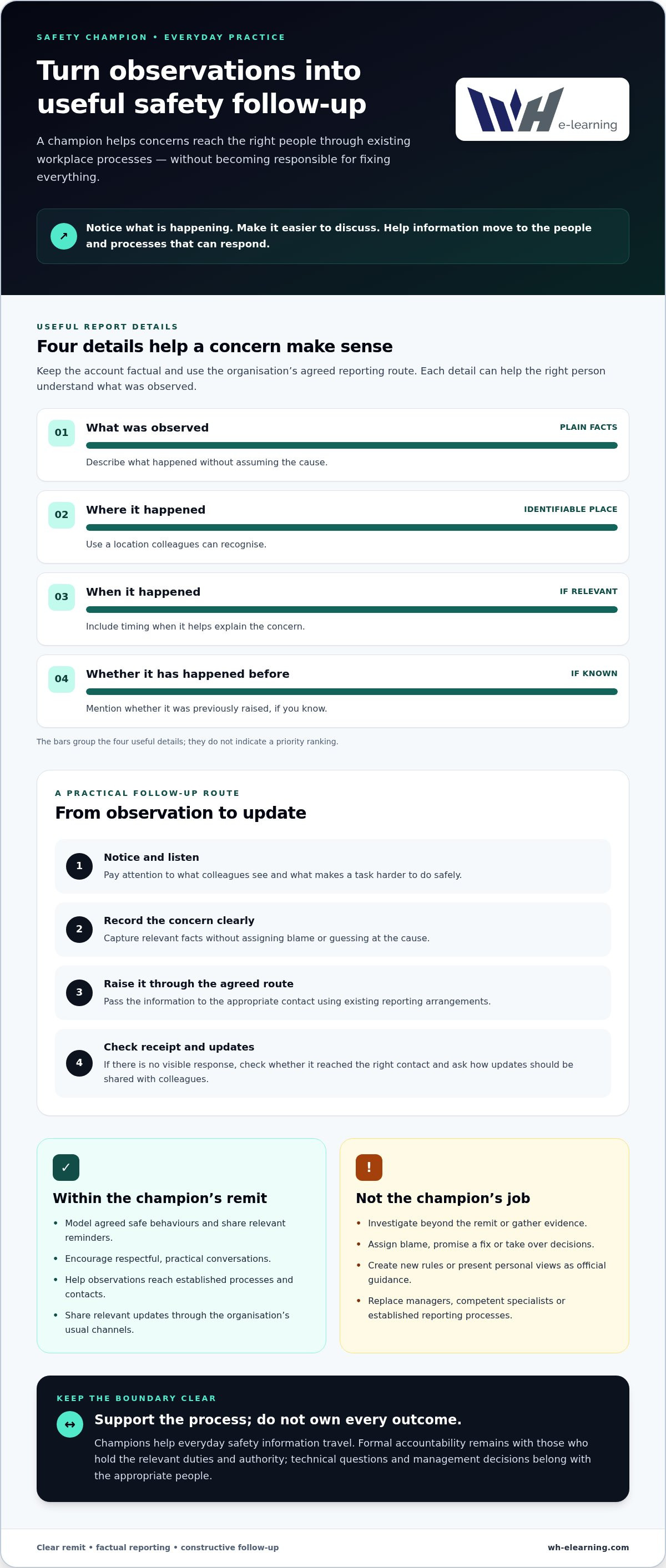
A useful report gives the right person enough detail to understand what was observed. Stick to clear, factual information and follow the organisation’s reporting and escalation arrangements. Depending on the process, it may help to note:
- What was observed, described plainly without assumptions about the cause.
- Where it happened, using a location colleagues can identify.
- When it happened, if the timing helps explain the concern.
- Whether the issue has happened before or was already raised, if known.
For example, rather than writing “the storage area is always unsafe”, a champion could record that boxes were left partly across a marked walkway near a particular work area during a shift. They can submit the concern through the agreed route. If there’s no visible response, the champion can check whether it reached the appropriate contact and ask how updates should be shared. That’s follow-up, not an investigation: don’t assign blame, gather evidence beyond the remit or promise a fix.
A clear remit and relevant learning can help champions communicate confidently and recognise when to refer a question. Organisations can support that capability with health and safety training courses, alongside clear procedures and management support.
What a Safety Champion Is Not: Clarify Accountability and Authority
A safety champion isn’t automatically responsible for everyone’s safety, every workplace decision or the resolution of every reported concern. The role can support safety arrangements, but it doesn’t by itself give someone authority to approve changes, direct colleagues or provide technical advice. Clear boundaries prevent an undefined workload and help colleagues understand who can make decisions.
Build that distinction into the safety champion roles and responsibilities from the start. The organisation should explain who the champion reports to, which concerns they can raise, how much time they can allocate to the role and what to do when an issue falls outside their remit. Without those details, a well-intentioned champion may be left trying to make decisions they aren’t equipped or authorised to make.
Champion, manager and safety professional: how the roles differ
Workplace arrangements vary, but the roles can be distinguished by their contributions. A champion may act as a local voice and communication link; managers make decisions assigned to them by the organisation; and a safety professional can advise on technical questions within their expertise. One role doesn’t replace the others.
Safety champion: Shares observations from day-to-day work, encourages colleagues to raise concerns and passes relevant information through agreed channels. They can help clarify whether a concern has reached the right person, but shouldn’t present themselves as the decision-maker unless that authority has been explicitly assigned.
Manager: Makes decisions that fall within their responsibilities and follows the organisation’s established processes. Depending on the workplace arrangements, this might include deciding how to address a reported issue or who should take it forward.
Safety professional or other specialist: Provides relevant expertise when an issue needs technical knowledge or assessment beyond the champion’s competence. The champion’s role is to make the connection, not guess at an answer.
For instance, if a colleague asks whether a particular piece of equipment is suitable for a task, the champion shouldn’t rely on assumption. They can direct the question to the appropriate manager or specialist and explain that they’ll use the agreed route to raise it. That response is helpful, honest and within bounds.
What should a champion do when a concern is urgent?
Use the workplace’s established emergency and escalation procedures. Don’t assume the champion has a universal power to stop work, and don’t wait for an informal conversation if the situation calls for urgent action under the organisation’s process. Communicate clearly and promptly with the appropriate responsible person, sharing the essential facts and following the relevant procedure.
For concerns beyond their knowledge or agreed remit, champions can say so and refer the issue through the correct channel. They shouldn’t investigate independently, promise a response time or imply that raising a concern means it has been resolved. A clear handover directs the issue towards someone with the appropriate responsibility, authority or expertise.
How to Make the Safety Champion Role Work in Practice
A safety champion role is more useful when there’s a simple, repeatable way to move an observation towards a response. Keep the process within existing workplace procedures, so employees know where to report concerns and the champion doesn’t create a parallel system. Agree the remit first, including what the champion can record, who receives concerns and how updates are shared.
A practical routine is:
- Agree the remit. Set out the champion’s scope, reporting line, allocated time and named contact.
- Listen. Give colleagues space to describe what they’ve noticed, without jumping to conclusions or promising a particular outcome.
- Record. Use the organisation’s established channel and provide the information it requests.
- Raise. Send the concern through the agreed route and escalate it according to workplace procedures where appropriate.
- Follow up. Clarify who owns the next step and whether the concern reached the right person.
- Share learning. Pass on relevant updates or recurring themes through an appropriate channel, respecting any limits on what can be shared.
A simple routine for raising and tracking safety concerns
Start with the existing reporting channel and its instructions. For example, if a champion hears that a storage arrangement is making an area harder to use, they can record the observation in the format the organisation requests and submit it through the usual route. They can then note whether it was communicated and clarify who is handling the next step, without creating a separate log that conflicts with workplace records.
A useful feedback loop turns an observation into a recorded concern, a clear handover and an update that helps the organisation respond.
How managers can support champions and review progress
Managers make the role workable by setting clear expectations, providing suitable induction and making a responsible contact accessible. Champions also need enough allocated time and access to relevant information to carry out their agreed tasks. These supports prevent the role from becoming an extra responsibility with no clear route for action.
Review the quality of follow-up, recurring themes and colleague feedback, not just the number of observations raised. A short check-in can establish whether concerns are reaching the right people, updates are getting back to the team and the process is easy to use. If the same type of concern keeps returning, discuss what the pattern may indicate and who should consider it.
For broader context on how learning supports workplace capability, explore this workplace safety training courses guide. WH eLearning also provides health and safety training options for organisations.
Build Safety Champion Capability with the Right Learning and Support
Clear boundaries make a champion’s contribution easier to sustain, but boundaries alone aren’t enough. People also need relevant learning, time to take part and visible support from managers. Together, these foundations help champions share information confidently, recognise when a question needs specialist input and use the organisation’s procedures consistently.
Learning should match the workplace, not just the role title. Consider the organisation’s activities, identified risks, the champion’s agreed remit and the processes they’re expected to follow. A practical induction can cover reporting routes, who to approach with different concerns, how to share updates and where the champion’s responsibilities end. Topic-specific learning can build knowledge relevant to the work without implying that the champion is qualified to make decisions beyond their competence.
Match learning to the champion’s remit
Start with what champions need to do in practice. If their remit includes encouraging conversations and passing on observations, they need a clear grasp of internal procedures and enough relevant health and safety knowledge to communicate responsibly. Broader occupational safety and health training can help organisations consider learning in the context of workplace needs and existing arrangements.
Make learning accessible across teams
Learning is easier to fit into a team’s routine when it’s accessible to people in different roles and working environments. WH eLearning offers over 100 video-based course titles across workplace topics, including health and safety. Courses are compatible with any device, include closed captions and are available in 25+ languages through machine translation. These features help organisations plan learning for teams with varied access and language needs.
Some organisations may benefit from specialist-led support. WH eLearning’s in-house courses combine theory and practical skills and are delivered by industry specialists. Professional health, safety and training consultancy can also provide specialist input. These options can strengthen wider capability, but they don’t replace clear reporting arrangements or turn a champion into a technical specialist.
As you shape support, consider whether champions can explain the agreed process, know where to direct questions and feel comfortable raising feedback. Managers can reinforce learning by making time for the role, discussing relevant themes and showing how concerns are handled. This keeps development connected to the work rather than treating training as a one-off activity.
The safety champion roles and responsibilities work best when practical learning, a clear remit and manager support reinforce one another. WH eLearning’s health and safety learning options can help build knowledge across your organisation.
Take the Next Step Towards Stronger Team Support
Turn the safety champion role into a practical commitment by choosing one improvement to make next. You could agree how the team shares observations or set aside time for champions to discuss what they’re hearing. A clear first step gives people something concrete to build on without making the role bigger than it needs to be.
Revisit the safety champion roles and responsibilities as the team’s work changes. Regular conversations can show whether the remit still makes sense, champions have the support they need and learning should address a new workplace priority. This keeps the role useful and connected to real working conditions.
Relevant learning can strengthen the knowledge behind everyday safety conversations. Explore WH eLearning’s health and safety training to support your organisation’s approach. With a clear purpose and the right support, champions can help teams make steady, constructive progress towards safer work.
Frequently Asked Questions
What does a safety champion do at work?
A safety champion helps make everyday safety easier to discuss and act on. They can model agreed behaviours, invite colleagues to share observations and pass concerns through the workplace’s established reporting route. For example, they might help a new team member find the correct channel for raising a concern. The exact remit depends on the organisation; champions aren’t investigators or decision-makers by default, and they don’t replace managers or relevant specialists.
Is a safety champion legally responsible for workplace safety?
The title “safety champion” alone doesn’t establish a universal legal responsibility or transfer an employer’s or manager’s duties. What a person is accountable for depends on applicable law, the organisation’s arrangements and any responsibilities formally assigned to them. If there’s uncertainty about a particular duty, check the relevant local requirements and internal procedures, and seek appropriate advice where legal interpretation is needed. Don’t rely on the title alone to define accountability.
Can any employee become a safety champion?
Employees in different roles and at different levels can be considered if they’re willing to listen, communicate clearly and work within an agreed remit. A suitable choice depends on the workplace, the team’s needs and the support available, rather than a particular job title or qualification. For example, a champion should know who to approach when a colleague raises a concern they can’t answer. Appropriate instruction and clear escalation routes help them contribute confidently.
Does a safety champion need a formal qualification?
There isn’t one universal qualification implied by the safety champion title. Learning needs depend on workplace risks, the responsibilities assigned and relevant organisational requirements. A champion may need practical preparation in internal procedures, whilst technical tasks may require specialist competence beyond the role. Organisations should provide suitable instruction and access to competent advice, rather than expecting champions to answer questions or perform tasks beyond their knowledge.
Can a safety champion stop work if they spot a hazard?
Not necessarily. Authority to stop or restrict work depends on the person’s role, the organisation’s procedures and applicable requirements, so champions shouldn’t assume they have that authority. If they spot an urgent concern, they should follow the workplace’s emergency and escalation arrangements and promptly alert the appropriate responsible person. They should communicate what they’ve observed clearly, without delaying action while trying to assess or resolve an issue beyond their remit.
How can a safety champion encourage colleagues to report hazards?
Make reporting straightforward and blame-free. A champion can explain which channel to use, listen without criticising and help a colleague identify the details the process asks for, such as the location or nature of a concern. They can also explain how the information will be passed on, without promising a particular outcome. Trust grows when the organisation follows up consistently and employees can see their concerns are being handled.
How can an organisation tell whether its safety champion is effective?
Look at whether colleagues understand how to raise concerns, observations reach the appropriate people and relevant updates are communicated back. Team feedback can show whether the champion is approachable and the reporting process is clear in practice. Review these indicators alongside recurring themes and completed follow-up, rather than relying on the number of reports or conversations alone. Appointing a champion by itself doesn’t guarantee fewer incidents or improved compliance.


