

A safety business case is strongest when it shows how preventing harm supports business performance. To understand how to write a health and safety business case, connect a clearly defined workplace risk to its direct and indirect costs, the investment needed to address it, and the outcomes the organisation can measure. The case should also explain what could happen if current risks remain.
It’s understandable for a safety proposal to compete with other priorities. A clear financial case makes it easier to assess: it connects injury prevention with costs such as claims, lost time and disruption, while recognising benefits such as steadier productivity and business continuity.
This article explains how safety investments can affect financial performance, how to account for the wider costs of workplace injuries and illnesses, and how to make a practical case for action. You’ll learn to use relevant evidence, connect a proposal to organisational priorities and describe the risks of maintaining the status quo, without presenting every benefit as an immediate cash saving.
Key Takeaways
- Assess organisational readiness and connect a safety proposal to priorities decision-makers already recognise.
- Look beyond immediate claims to the wider costs of injuries, including disruption and lost productivity.
- Show what maintaining current risks could mean for people, operations and financial performance.
- Build a clear case with relevant evidence, realistic expected costs and benefits, and measurable outcomes.
How can investing in workplace safety and health improve your organization's financial performance?
Assess readiness by identifying a workplace risk, the people affected and the resources available to address it. Then link the proposed investment to outcomes leaders already track, such as productivity or business continuity.
Johnson & Johnson’s worksite health promotion and disease prevention programme was also cited as producing a positive return on investment in 2002.
Aligning investment with organisational priorities
Alignment means showing how an environmental, health and safety investment supports a priority the organisation already values. This helps leaders weigh the proposal alongside other business needs, rather than treating safety as a separate concern. For example, link a training initiative to reduced operational disruption, stable production or stronger workforce relationships. Explain which outcome matters most and how progress could be assessed.
Before presenting a proposal, assess whether the organisation can put it into practice. Identify the teams affected, the managers who will support the change, the resources required and any operational constraints. Check whether incident records or employee feedback point to a clear need. A proposal based on a specific workplace risk gives leaders a stronger basis for weighing the investment against competing priorities.
Ask leaders focused questions: Which operational priority should this initiative support? What evidence would show progress? Which teams need to take part? How will the organisation review results? The answers help shape a proposal around real decision criteria.
Examples of successful safety business cases
Successful examples show how a defined investment can connect safety activity with financial or organisational outcomes. The forest products company case links training and workplace improvements with lower compensation and other costs. Johnson & Johnson’s programme shows how health promotion can also be presented as an investment with a positive return. Use these examples to frame a proposal, then explain how its risks, priorities and measures apply to your organisation.
Direct and indirect costs of workplace injuries and illnesses
Build a cost picture using recorded claims, work disruption and time spent managing incidents. Separate measurable costs from operational effects so leaders can compare the investment with realistic potential savings.
Direct and indirect incident costs
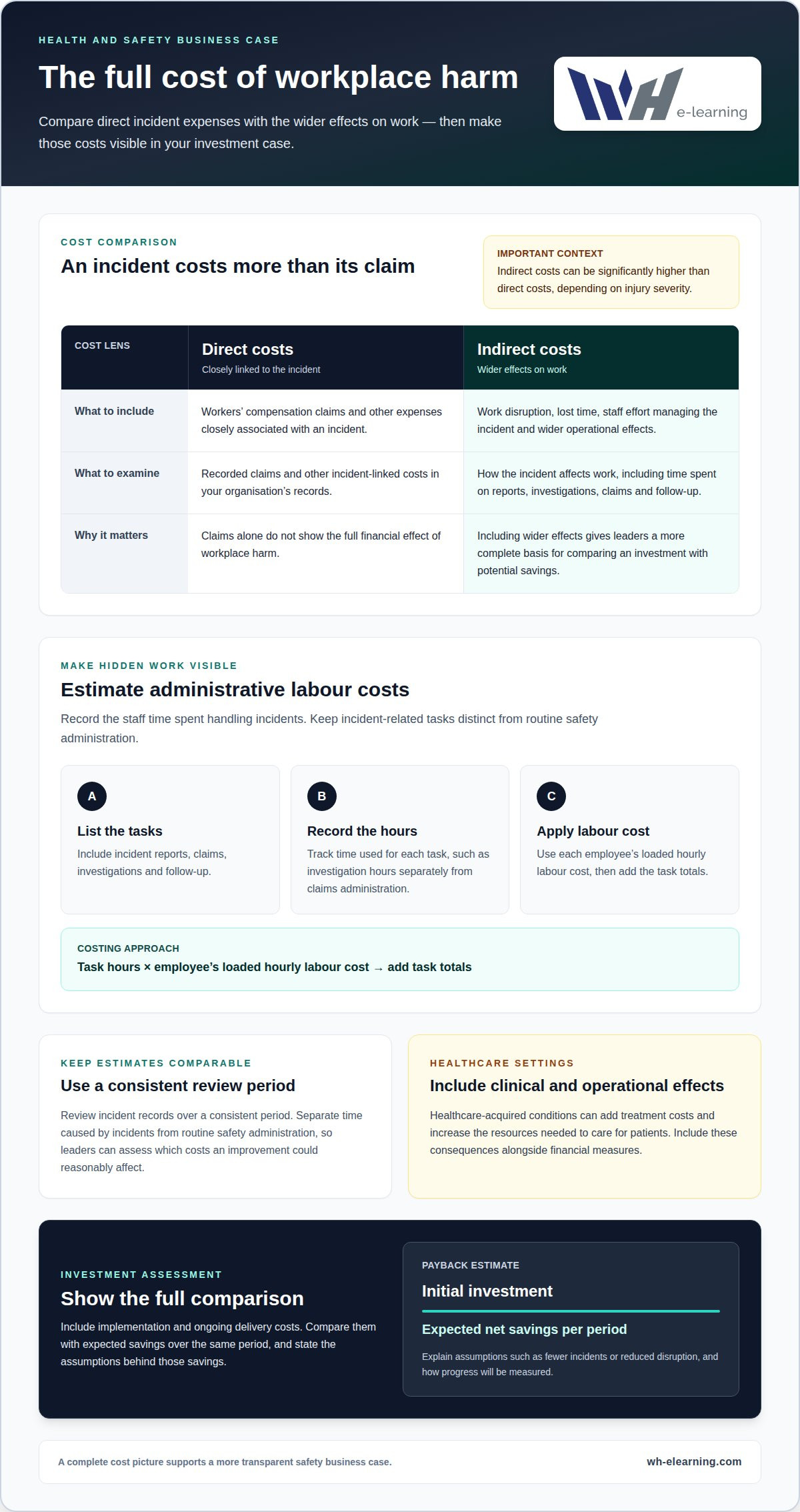
Direct costs are expenses linked closely to an incident, such as workers’ compensation claims; indirect costs arise through its wider effects on work. Industry research indicates indirect workplace injury costs can be significantly higher than direct costs, depending on injury severity. Include both when estimating the potential return on investment, rather than relying on claims alone.
For scale, employers often pay substantial sums every week in direct workers’ compensation costs for disabling, non-fatal workplace injuries, according to national workplace safety indices. These figures show why an organisation should examine its own incident records and operational effects.
Administrative labour costs
Administrative labour costs are the staff time spent handling incident reports, claims, investigations and follow-up. To estimate them, list the tasks, record the hours used and apply each employee’s loaded hourly labour cost. For example, calculate investigation hours separately from claims administration, then add the totals. This makes hidden work visible when learning how to write a health and safety business case.
Use a consistent period when reviewing records, and distinguish time caused by incidents from routine safety administration. This helps leaders assess which costs an improvement could reasonably affect.
Healthcare-acquired conditions can add treatment costs and increase the resources needed to care for patients. A healthcare business case should therefore account for clinical and operational consequences alongside financial measures. Define the investment’s full costs, including implementation and ongoing delivery through programmes like WH eLearning, then compare them with expected savings over the same period.
Estimate payback by dividing the initial investment by expected net savings per period. State the assumptions behind those savings, such as fewer incidents or reduced disruption, and explain how the organisation will measure progress. This gives decision-makers a transparent basis for assessing the proposal.
Explaining the risks of maintaining the status quo
Assess risks by identifying hazards, who could be exposed, how harm might occur and which safeguards are already in place. Prioritise controls by considering potential harm, exposure and how effectively proposed measures could reduce the risk.
Make the consequences of inaction specific to the organisation. Describe the people, processes and assets exposed, then estimate the disruption that could follow if existing controls fail. Include operational effects such as interrupted production, reduced staffing or delayed services. Separate documented incidents from credible future scenarios so leaders can distinguish evidence from projections.
The 2013 West Fertilizer Company explosion in Texas shows how harm can extend beyond a worksite. It killed 15 people, injured more than 260 and damaged 350 of the community’s 700 homes. Of those, 142 homes were damaged beyond repair. Use the example to show why a risk review should consider workers, neighbouring communities and business continuity.
For each priority risk, record the current control, its limitations and the proposed improvement. Then explain the likely consequences if the organisation takes no further action. The Deepwater Horizon incident killed 11 people and injured 17 others. Such cases illustrate how severe incidents can create consequences across several areas.
Regulatory exposure can also form part of a US business case. OSHA serious violation penalties reach $15,625 per violation, while penalties for willful or repeated violations can reach $156,259 each. Present these figures as possible exposure, not as a forecast of a particular organisation’s penalties. Explain which risks the proposed controls address and how leaders can monitor implementation.
Rank actions transparently: address risks with the greatest potential for harm first, then compare how well each control reduces exposure and supports operations. A clear record of hazards, existing safeguards, proposed actions and responsible teams gives decision-makers a practical view of the status quo and the case for change.
Drafting a business case for safety work
A health and safety business case sets out the risk, proposed action, expected costs and benefits, and decision needed. Understanding how to write a health and safety business case helps leaders compare safety work with other organisational priorities.
Defining a health and safety business case
AIHA defines an EHS business case as a structured method for justifying a project or intervention to decision-makers. For safety work, bring together evidence about the problem, the proposed response and the outcomes the organisation expects to assess. Use measures leaders recognise, such as cost savings, productivity or employee retention. Work with Finance partners to estimate costs and gains, separating financial measures from impacts that are harder to monetise, such as morale.
Presenting the case to executives
Presenting a case to executives means turning safety evidence into a concise decision paper or briefing. If you’re considering how to write a health and safety business case for senior leaders, lead with the business problem, then set out the recommended action, required resources, expected gains and risks of doing nothing. The Institute for Healthcare Improvement and the National Patient Safety Foundation toolkit recommends collaboration between patient safety and finance leaders on organisational investment cases.
Build the proposal around evidence relevant to your organisation. Describe the current challenge accurately, connect it to strategic priorities and use comparable examples to support the proposed approach. Explain how the organisation will evaluate results, including financial measures and operational effects. Make assumptions visible so decision-makers can see how projected benefits relate to evidence, rather than treating estimates as guaranteed savings.
Plan the decision process as carefully as the financial analysis. Begin developing a workplace safety business case at least 120 days before the new budget year begins. Identify who needs to contribute, when Finance will review the figures and what approval is required. End with a clear next step, such as further research, stakeholder meetings, a capital planning review or a small pilot.
For workplace learning that supports an approved safety initiative, explore Health and Safety Training Courses and shape training around the needs identified in your case.
WH eLearning: Health and Safety Training Courses
WH eLearning offers Health and Safety Training Courses to support organisations putting an approved safety initiative into practice. Its online course library includes over 100 video-based courses covering workplace topics, including health and safety, HR and business compliance. Learners can access courses on any device, with closed captions and machine translation into more than 25 languages.
Choose training that reflects the risks and learning needs identified in your business case. Online courses suit organisations looking for a flexible way to deliver learning, while In-House Face-to-Face Training provides an in-person option. Multi-language Course Translation can support teams who need course content in different languages. HR and Business Compliance Courses can also address related workplace learning priorities.
Contact WH eLearning to discuss training for your safety initiative.
Turn your safety proposal into practical progress
A business case can do more than support a funding decision. It can give teams a shared starting point for putting safety priorities into practice, clarifying who needs to act and what learning could help. Knowing how to write a health and safety business case also means planning for implementation, so the next step follows naturally from the decision.
Training can help translate an approved initiative into workplace learning. WH eLearning offers Health and Safety Training Courses, including IOSH Managing Safely Online and IOSH Working Safely Online. Choose an option that fits the learning needs identified in your proposal, then make the next move at a pace that works for your organisation. Contact WH eLearning to discuss your needs and explore a suitable training route. A clear case gives you a strong foundation; thoughtful action helps carry it forward.
Frequently Asked Questions
Why Build a Business Case?
A business case gives decision-makers a reasoned basis for choosing safety work over competing uses of time and resources. It can clarify whether the priority is reducing exposure, improving operational resilience or addressing a recurring workplace problem. It also provides a reference point for reviewing the decision later, so leaders can compare expectations with what the organisation observes after implementation.
What sections should a health and safety business case include?
Include a concise decision request, a description of the workplace problem, evidence supporting the need and the options considered. Add the preferred approach, delivery responsibilities, resource requirements and measures for reviewing progress. A short section on assumptions helps readers distinguish recorded evidence from estimates. If different teams are affected, identify their roles so the proposal can move from approval to coordinated action.
How do you calculate the ROI of workplace safety investments?
Calculate ROI by subtracting investment costs from the financial benefits, dividing the result by the investment costs, then multiplying by 100. Define which benefits count as financial savings before doing the calculation. For example, distinguish avoided expenditure from productivity improvements that are harder to convert into cash. Show the calculation period and assumptions, then test how the result changes if expected savings are lower.
What data and metrics should support a health and safety business case?
Use evidence that reflects the specific risk and the outcome the proposal aims to change. Relevant measures may include incident types, severity, absence, near-miss reports, equipment damage and time lost to disruption. Pair these with operational indicators, such as work completed or staffing stability, when they relate to the proposal. Keep definitions consistent across reporting periods so decision-makers can make a fair comparison.
How do you estimate the costs of workplace injuries and illnesses?
Build an estimate from several records rather than relying on a single headline figure. For a specific incident, combine claim or treatment records with payroll data, replacement staffing, overtime, repair costs and investigation time. Ask relevant teams to identify disruption that financial systems may not capture directly. Keep each cost category separate and remove overlaps, such as counting the same employee hours as both absence and replacement labour.
How do you compare the costs and benefits of safety interventions?
Compare each option against the same risk, time period and outcome measures. Include the do-nothing option, the preferred intervention and any practical alternative, then assess implementation effort, ongoing costs and remaining exposure. Separate cash savings from benefits such as improved confidence or continuity. A sensitivity check using cautious and stronger benefit assumptions helps leaders see whether the preferred option still makes sense under different conditions.


